Updated: August 17, 2026
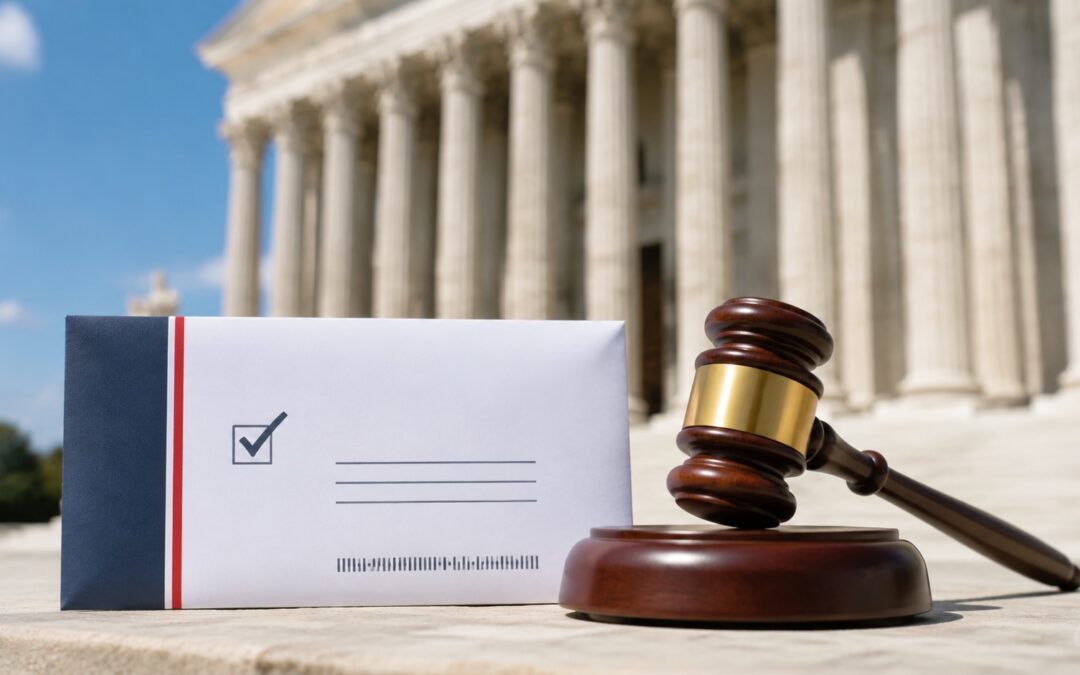
A federal judge has temporarily blocked the U.S. Postal Service from implementing new nationwide restrictions on mail-in and absentee ballots before the November 3, 2026, midterm elections.
The ruling preserves existing state voting procedures while the legal challenges continue. For now, voters should follow the mail-voting rules and deadlines published by their state election office.
What This Means for Voters
- The Postal Service cannot impose the new ballot-envelope and voter-list requirements for the November 3 election.
- States may continue administering absentee and mail voting under their existing laws.
- Eligible voters may still request, receive and return mail ballots when permitted by state law.
- Deadlines and eligibility rules remain different in every state.
- The Supreme Court could still intervene before Election Day.
Important: This ruling does not make mail-voting rules identical nationwide. Always confirm your eligibility, application deadline and ballot-return deadline with your state or local election office.
What the Executive Order Proposed
President Donald Trump signed Executive Order 14399 on March 31, 2026. The order was titled “Ensuring Citizenship Verification and Integrity in Federal Elections.”
Section 3 directed the Postal Service to develop nationwide rules for mail-in and absentee ballots used in federal elections.
The proposed system would have required:
- Official Election Mail markings on outbound ballot envelopes.
- Automation-compatible envelopes with unique tracking barcodes.
- Postal Service review of ballot-envelope designs.
- States to notify the Postal Service before using the mail for absentee or mail ballots.
- State-specific lists identifying voters participating in mail voting.
- The Postal Service to decline to transmit mail ballots for voters who were not enrolled on the applicable list.
Other sections directed federal agencies to compile state-by-state citizenship information and called for federal investigations or prosecutions involving ballots issued to people considered ineligible under federal or state law.
The administration said the changes were intended to strengthen citizenship verification, ballot tracking and election security.
What the Court Blocked
On August 11, U.S. District Judge Indira Talwani issued a preliminary injunction in League of Women Voters of Massachusetts v. Trump.
The order prevents the Postal Service and related federal officials from implementing Section 3 for the November 3 election or any earlier federal election.
Specifically, the federal government cannot:
- Require new federally prescribed designs or technology for ballot envelopes.
- Require voters to enroll on a Postal Service mail-ballot list.
- Refuse to carry a ballot because the voter is not on such a list.
- Require states to submit lists of mail-ballot voters to the Postal Service.
- Complete or enforce the rulemaking directed by Section 3 for the upcoming election.
Judge Talwani concluded that the challengers were likely to succeed on their claim that the executive branch lacks the constitutional authority to impose these election rules. The Constitution generally assigns election administration to the states, subject to laws enacted by Congress.
The ruling is a preliminary injunction, not a final decision resolving the entire case. It keeps the challenged restrictions from taking effect while litigation continues. Read the August 11 court order.
What Remains Permitted
The ruling preserves the current system for the November election.
States may continue to:
- Determine who qualifies to vote by mail.
- Set deadlines for requesting and returning ballots.
- Use existing ballot envelopes and tracking systems.
- Verify voter eligibility under state and federal law.
- Count ballots according to state law.
- Offer no-excuse mail voting, excuse-based absentee voting or primarily mail-based elections where authorized.
The Postal Service may continue carrying election mail under its existing procedures. The court also said the federal government may provide nonbinding guidance about ballot-mail envelopes.
That distinction matters: the Postal Service may offer operational recommendations, but it cannot enforce the specific nationwide restrictions described in Section 3 before the November 3 election.
State Deadlines Still Apply
The injunction does not extend or replace state deadlines.
Depending on the state, a mail ballot may have to be:
- Received by election officials before polls close on Election Day.
- Postmarked by Election Day and received during a later statutory window.
- Returned to an authorized drop box or election office by a specified time.
Some states allow any eligible voter to request a mail ballot. Others require an approved reason, such as illness, disability, age or absence from the jurisdiction.
Voters should not assume that requesting a ballot close to the official deadline leaves enough time for postal delivery.
The Pending Supreme Court Request
The Trump administration and a group of Republican-led states have asked the Supreme Court to pause a related injunction issued in Trump v. California.
That earlier order blocked portions of the executive order in 23 states and the District of Columbia. The U.S. Court of Appeals for the First Circuit declined to lift it, prompting emergency applications at the Supreme Court.
The federal government filed additional material with the Court on August 12 following the nationwide ruling. The administration argues that the challenges were filed too early because the Postal Service had not completed a final rule. The states and voting-rights groups opposing the request argue that election officials require certainty before ballots and envelopes are prepared.
As of August 17, the emergency requests remained pending. They are listed as Supreme Court applications 26A124 and 26A139.
If the Supreme Court grants a stay, some or all of the blocked provisions could potentially move forward while the appeals continue. If it denies the requests, the lower-court protections will remain in place unless another court order changes the situation.
What Voters Should Do Now
- Check your registration. Verify that your name and address are correct.
- Confirm whether you qualify to vote by mail. Eligibility requirements differ by state.
- Request your ballot early. The legal dispute does not change state application deadlines.
- Read the return instructions carefully. Signature, witness, identification and envelope requirements vary.
- Return the ballot with time to spare. If Election Day is close, check whether an official drop box or election-office return is available.
- Track your ballot when your state offers tracking. Contact your local election office promptly if the system reports a problem.
Find Your Official State Election Office
Use these federal directories to reach your state’s official election website:
- U.S. Election Assistance Commission state voting directory
- USA.gov state and local election office directory
- Check your voter-registration status
The Election Assistance Commission advises voters to verify registration information, voting options and deadlines through the linked state and local sources because every state administers elections differently.
Call Your Senate · 2026 Election Center
Follow the Races That Will Shape the Next Senate
The November 3 election will determine 35 U.S. Senate seats. See the candidates, compare active races and find the contests affecting your state.
Frequently Asked Questions
Has mail voting been suspended?
No. Mail and absentee voting remain available under each state’s existing laws.
Can the Postal Service refuse my ballot under the executive order?
Not under the provisions currently blocked for the November 3 election. Voters must still comply with their state’s eligibility and return requirements.
Did the court permanently cancel the executive order?
No. The preliminary injunction temporarily blocks Section 3 while the case proceeds.
Does the ruling change my state’s ballot deadline?
No. State application, postmark and receipt deadlines continue to apply.
Could the rules change again before Election Day?
Yes. The Supreme Court is considering emergency requests involving a related injunction. Voters should monitor their official state election office for authoritative updates.
The Bottom Line
The court’s August 11 order prevents the Postal Service from imposing the executive order’s new mail-ballot lists, envelope standards and transmission restrictions for the November 3 election.
Existing state rules remain in effect. Voters who plan to vote by mail should verify their registration, request their ballot early and follow their state’s official return instructions.
Call Your Senate will update this article if the Supreme Court acts or another court changes the legal status of the executive order.
Primary sources: Executive Order 14399; U.S. District Court order dated August 11, 2026; U.S. Election Assistance Commission; USA.gov election-office directory.
