Published: August 26, 2026
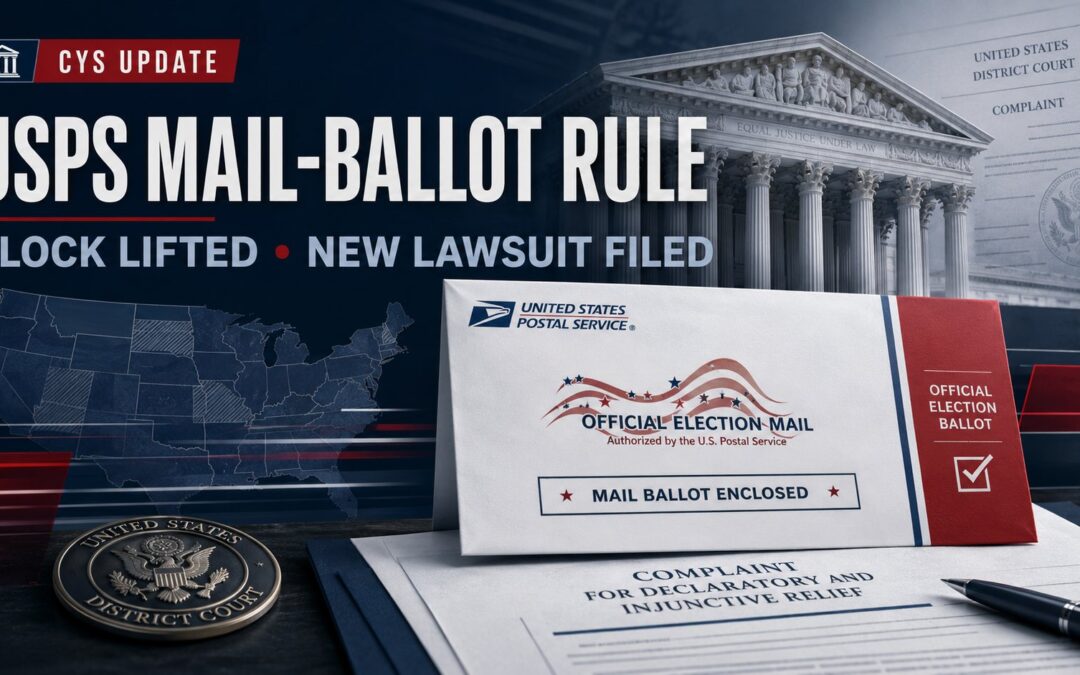
A federal judge has lifted the remaining court order blocking the U.S. Postal Service from moving forward with new requirements for mail ballots in federal elections.
But the legal fight is not over.
Hours after the restriction was lifted, a coalition of state attorneys general and Pennsylvania Gov. Josh Shapiro filed a new lawsuit challenging the finalized USPS rule itself. Voting-rights organizations are also seeking renewed court action.
The result is another major shift in the legal status of mail voting just weeks before ballots begin going out for the November 3 midterm elections.
What This Means
For now, the previous court orders preventing USPS from implementing the new mail-ballot system have been removed.
That does not mean the Supreme Court has ruled that the new USPS requirements are constitutional or lawful.
Instead, the Supreme Court’s August 24 ruling focused on whether an earlier lawsuit had been filed too soon — before USPS had issued a final rule.
Now that USPS has finalized that rule, states and voting-rights organizations are challenging the actual requirements directly.
Key Details
- The Supreme Court lifted one injunction on August 24.
- A second federal injunction was lifted on August 26.
- USPS’s final mail-ballot rule was formally published in the Federal Register on August 26.
- The rule creates new requirements for states sending ballots through the mail in covered federal elections.
- A new lawsuit filed August 26 challenges the finalized rule.
- The challengers are asking courts to block implementation while the case proceeds.
- No court has yet issued a final ruling on whether the USPS rule itself is lawful.
Why the Second Injunction Was Lifted
U.S. District Judge Indira Talwani had previously issued a nationwide preliminary injunction in League of Women Voters of Massachusetts v. Trump that prevented USPS from implementing Section 3 of President Donald Trump’s March 31 election executive order for the November election.
On August 26, Talwani lifted that injunction.
Her decision followed the Supreme Court’s August 24 ruling in a separate case, Trump v. California.
The Supreme Court concluded that states challenging the executive order had gone to court too early because USPS had not yet issued its final rule when the lawsuit was filed.
Talwani said the Supreme Court’s reasoning required her to reconsider the separate injunction in the League of Women Voters case.
The removal of that order clears the immediate legal obstacle that had prevented USPS from moving forward.
However, Talwani also allowed the plaintiffs to update their case now that the USPS rule actually exists.
That distinction could become important in the next phase of the litigation.
What Did the Supreme Court Actually Decide?
The Supreme Court’s August 24 ruling did not decide whether President Trump’s mail-voting policy is constitutional.
The Court focused instead on a legal concept called standing.
Standing determines whether someone bringing a lawsuit has suffered, or faces, the type of concrete injury necessary for a federal court to hear the case.
When the states initially sued, President Trump’s executive order directed USPS to develop a mail-ballot regulation. The final regulation did not yet exist.
The Supreme Court majority said federal courts should not decide whether a hypothetical future regulation harms states before that regulation is finalized.
The Court specifically stated that its decision did not mean future implementation measures would necessarily be lawful.
It also made clear that states could challenge the final USPS rule if that rule caused them legal harm.
That is now happening.
What Does the New USPS Rule Require?
The Postal Service’s final rule, “Ballot Mail for Federal Elections,” establishes new standards for certain mail-in and absentee ballots used in federal elections.
Among the requirements, election officials would generally have to use ballot envelopes that:
- Display the Official Election Mail logo.
- Meet USPS automation standards.
- Include unique Intelligent Mail barcodes.
- Receive USPS design review.
Election officials would also be required to provide specified ballot-mail information through a new Federal Ballot Mail Portal before presenting covered outgoing ballot mailings to USPS.
That information can include a voter’s name, mailing address and identifying barcode information associated with the outgoing and return ballot envelopes.
USPS says the system is designed to regulate the preparation, acceptance and tracking of federal ballot mail.
The Postal Service says it will not determine whether a person is legally eligible to vote, decide citizenship status, open completed ballots or determine whether a ballot should ultimately be counted.
Those responsibilities remain with state and local election authorities.
The rule nevertheless gives USPS a role in determining whether covered ballot mailings meet postal requirements before they enter the mail system.
That new federal role is at the center of the latest lawsuits.
States File a New Lawsuit
On August 26, a coalition led by the attorneys general of California, Massachusetts, Nevada and Washington filed a new federal lawsuit against USPS.
The coalition includes roughly two dozen attorneys general as well as Pennsylvania Gov. Josh Shapiro.
Unlike the earlier case, this lawsuit challenges the final USPS regulation, rather than only the executive order directing USPS to create one.
The states argue that the Postal Service exceeded its legal authority and improperly interfered with state administration of elections.
They also argue that implementing the changes shortly before the November election could create financial, logistical and administrative burdens for state and local election officials.
The lawsuit raises claims involving the Constitution, federal postal law, privacy law and federal election law.
Those are allegations made by the states. The courts have not yet issued a final decision on those claims.
The coalition is asking the federal court for a temporary restraining order and preliminary injunction that would prevent USPS from implementing the rule while the case is litigated.
What Is the Administration’s Position?
The Trump administration has argued that the president’s executive order is intended to strengthen election integrity and ensure that federal agencies use their existing authority to protect federal elections.
USPS, meanwhile, describes its rule as an exercise of its authority to establish standards governing mail preparation, acceptance and processing.
The Postal Service maintains that the rule does not transfer control over voter eligibility from the states to USPS.
That question — whether USPS is simply regulating the mail or unlawfully regulating the election process itself — is likely to be a central issue as the litigation proceeds.
Why This Case Is Different Now
This is an important procedural change.
Earlier lawsuits challenged an executive order telling USPS to create a rule.
The Supreme Court said those challenges were premature because courts did not yet know exactly what the final Postal Service requirements would be.
Now the final rule exists.
The Supreme Court wrote in its August 24 decision:
“If the Postal Service’s final rule harms the States, they may challenge that rule.”
The states are now doing exactly that.
That means the next court fight can focus directly on the legality of specific USPS requirements rather than predictions about what a future rule might contain.
What Does This Mean for Mail Voters?
The most important thing for voters is that individual voters should continue following instructions from their state and local election officials.
The new USPS requirements are largely directed at election offices and the organizations that prepare and send ballot mail, rather than requiring individual voters to register separately with USPS.
Voters should continue to:
- Confirm that they are registered to vote.
- Check their state’s rules for requesting a mail or absentee ballot.
- Follow the instructions included with their ballot.
- Return ballots as early as possible.
- Use official ballot-tracking systems where available.
- Check their state or local election office for any changes before Election Day.
Mail-voting rules differ from state to state, and ongoing litigation could change how the federal USPS requirements are implemented.
What Happens Next?
The next major development could come quickly.
The states have asked the federal court to temporarily block the final USPS rule while their new lawsuit proceeds.
Voting-rights organizations involved in the separate League of Women Voters case are also seeking renewed relief based on the now-finalized regulation.
A federal judge could grant or reject those requests, and either side could appeal.
That means the dispute could return to a federal appeals court — and potentially the Supreme Court — before the November election.
Current Status — August 26, 2026
The earlier injunctions blocking the USPS mail-ballot policy have been removed. USPS can move forward with the final rule for now. However, new lawsuits directly challenging the finalized regulation are already underway, and challengers are seeking emergency court orders that could block implementation again.
The Supreme Court has not issued a final ruling determining whether the USPS mail-ballot rule itself is constitutional or otherwise lawful.
Call Your Senate will continue tracking the litigation and update readers if another court changes the rule’s status before the November 3 election.
