The Trump administration is making some of the most significant federal moves involving voter eligibility in decades. But the evidence behind its central argument — widespread noncitizen voting — is more complicated than the political rhetoric suggests.
As the November 3, 2026 midterm elections approach, President Donald Trump and his administration are pushing major changes to how voter eligibility is checked, how state voter rolls interact with federal databases, and how mail ballots move through the U.S. Postal Service.
The justification is straightforward: Only U.S. citizens can legally vote in federal elections, and the administration says existing safeguards are not strong enough to ensure that rule is being followed.
That raises an equally straightforward question:
How many noncitizens are actually voting illegally in American elections?
The answer matters.
If widespread illegal voting is occurring, stronger safeguards could address a serious vulnerability in the election system.
If illegal voting is extremely rare, policymakers must also consider whether sweeping new verification systems could create a larger problem by mistakenly delaying, challenging or removing eligible American voters.
The available evidence confirms that noncitizens have voted illegally in U.S. elections.
But it does not establish that noncitizen voting has occurred on the massive scale frequently suggested in political rhetoric.
What This Means
Here is the short version:
- Voting in federal elections by noncitizens is already illegal.
- Federal prosecutors have successfully prosecuted individual noncitizens for voting.
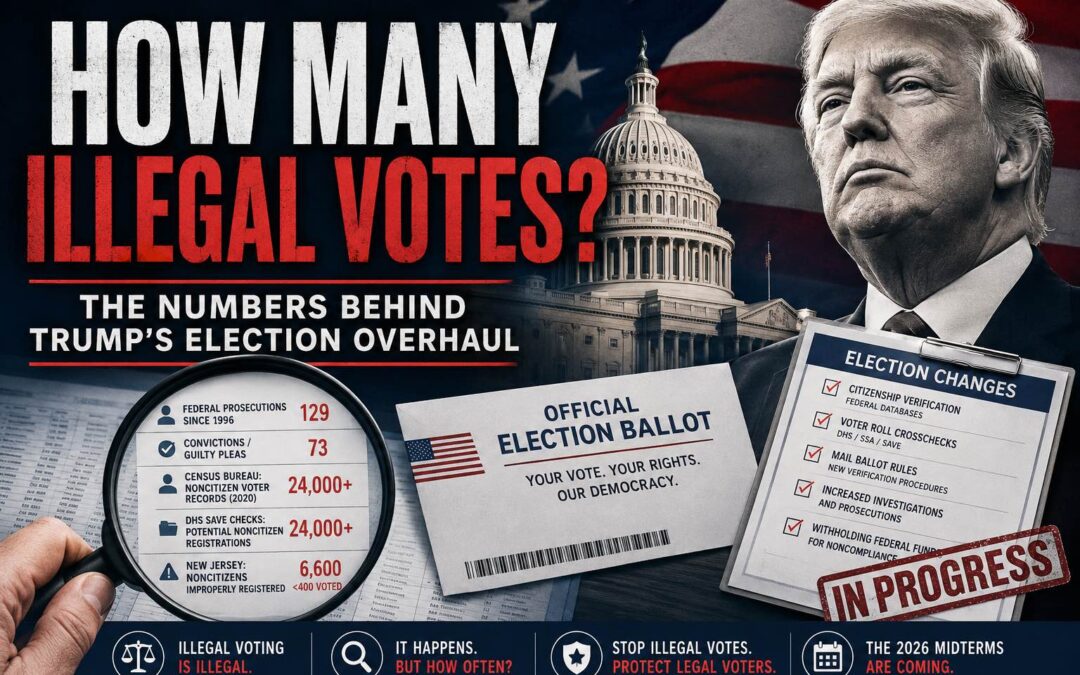
- Reuters identified 129 federal prosecutions under the federal noncitizen-voting law since it was enacted in 1996.
- Of those cases, Reuters found 73 convictions or guilty pleas as of July 2026.
- A new Census Bureau analysis says it identified more than 24,000 voter records associated with people it classified as noncitizens in the 2020 election, but the analysis is preliminary and its methodology has been challenged by election experts.
- DHS voter-registration checks have separately flagged tens of thousands of people as potential noncitizens.
- Being flagged as a potential noncitizen, being improperly registered and actually casting an illegal ballot are three different things.
- There is currently no verified national count demonstrating that hundreds of thousands or millions of noncitizens cast ballots in a federal election.
That leaves a legitimate policy debate:
Do the documented cases justify dramatically expanding federal involvement in voter verification shortly before the 2026 midterms?
The administration says yes.
Critics — including some Republican election officials — say the current evidence does not demonstrate a problem large enough to justify the risks created by the proposed response.
First, Noncitizen Voting Is Illegal
There should be little confusion about the underlying law.
Federal law generally prohibits a noncitizen from voting in an election involving candidates for federal office.
President Trump’s March 31, 2026 executive order on election integrity repeatedly cites those existing federal prohibitions. The administration argues that federal agencies have a responsibility not simply to punish violations after they occur, but to prevent ineligible people from entering the voting system in the first place.
The order directs the Department of Homeland Security, working with the Social Security Administration and other federal databases, to create state-specific citizenship information that can be used by election officials.
It also directs federal agencies to prioritize investigations involving illegal voting and calls for additional requirements surrounding mail and absentee ballots.
The policy question, therefore, is not whether noncitizens should be allowed to vote in federal elections.
They cannot.
The disagreement is over how often illegal voting occurs — and how aggressive government should become in trying to prevent it.
How Many Noncitizens Have Actually Been Prosecuted for Voting?
One of the most useful measurements comes from a Reuters investigation of federal court records published in July 2026.
Reuters identified 129 people charged under the federal “voting by aliens” statute since Congress enacted it in 1996.
Among those cases:
- 73 resulted in convictions or guilty pleas
- 30 were dismissed
- 26 remained pending
- Reuters found no case in which federal prosecutors alleged a coordinated conspiracy designed to influence an election
- Among the defendants whose political affiliation could be determined, the cases included Democrats, Republicans and people without a party affiliation
Reuters also found that the Trump administration had significantly increased enforcement. At least 39 noncitizen-voting prosecutions had been filed during the preceding 18 months.
Those prosecutions prove an important point:
Noncitizen voting is not imaginary. It happens.
Recent Justice Department cases provide concrete examples.
In June 2026, three noncitizens pleaded guilty in separate Florida federal cases involving illegal voting and related offenses.
A French citizen pleaded guilty in New Jersey to illegally voting in the 2022 federal midterm election.
A British citizen living in Texas admitted illegally voting in multiple elections, including federal elections in 2012, 2016, 2018, 2020 and 2024.
Other prosecutions or charges have recently occurred in Hawaii, South Carolina, Pennsylvania, Massachusetts and New Jersey.
So there is unquestionably illegal voting that deserves enforcement.
But those cases still do not establish widespread election-changing fraud.
What About the Census Bureau’s Claim That 24,000 Noncitizens Voted?
This is now one of the most important numbers in the debate.
In August 2026, the U.S. Census Bureau released what it called a “beginning analysis” of the 2020 election.
The Census Bureau said it compared commercial voter-file information with federal government records and determined with what it described as high confidence that more than 24,000 voter records represented noncitizens at the time of the 2020 election.
Nearly 160 million votes were cast nationwide in that election.
The Census Bureau also said more than 32 million voter records remained to be analyzed when the preliminary report was published.
If all 24,000 records ultimately represented actual illegal ballots, they would equal roughly 0.015% of the approximately 160 million ballots cast in 2020 — about 15 ballots for every 100,000 votes.
But there is a major caveat.
Election experts have challenged the report’s methodology.
The Associated Press reported that experts said the matching process could produce false positives when, for example:
- a citizenship record has not been updated after naturalization;
- a person is matched to the wrong address;
- government databases contain outdated information; or
- voter-file records are incorrectly matched with federal records.
Experts also noted that information normally used to evaluate a statistical analysis — including detailed error-rate information — was missing from the preliminary report.
That means the 24,000 figure should not currently be treated as a final, independently verified count of 24,000 illegal ballots.
It is evidence requiring further examination.
Registration Is Not the Same as Voting
This distinction may be the most important one in the entire debate.
Federal officials have also reported much larger numbers of potentially ineligible registrations.
At least 67 million voter registrations have been checked through an expanded version of DHS’s Systematic Alien Verification for Entitlements, or SAVE, program.
USCIS said checks of approximately 60 million registrations identified around 24,000 potential noncitizens.
The checks also flagged hundreds of thousands of records involving people who appeared to have died.
But these categories cannot be combined.
There is an enormous legal and factual difference between:
1. A person being flagged by a database
2. A noncitizen being registered
3. A noncitizen actually casting a ballot
4. A noncitizen knowingly committing voter fraud
A database match is the beginning of an investigation, not necessarily proof of a crime.
Even supporters of the SAVE system have described it as an investigative starting point rather than a final determination.
New Jersey Shows Why the Distinction Matters
New Jersey recently disclosed one of the clearest examples.
According to the Associated Press, about 6,600 noncitizens were improperly registered through the state’s motor-vehicle system during 2023 and 2024.
State officials said those individuals had actually answered “no” when asked whether they were U.S. citizens, but a vendor error nevertheless resulted in their registrations.
That is a serious administrative failure.
But the next number matters just as much.
New Jersey Gov. Mikie Sherrill said fewer than 400 of those approximately 6,600 people had voted.
Even that does not automatically establish that every one of those votes represented a knowing federal crime; individual eligibility, election type and circumstances would still need examination.
The episode demonstrates why the words used in election reporting matter.
“6,600 noncitizens registered” does not mean “6,600 illegal votes.”
Federal Checks Are Also Flagging Actual Citizens
Another concern has emerged as states begin using federal citizenship databases more aggressively.
Some eligible U.S. citizens have been incorrectly identified as potential noncitizens.
The Associated Press documented the case of Anthony Nel, a Texas voter who came to the United States from South Africa as a child and became a citizen through his parents.
Despite being a citizen for years, he was flagged by a SAVE check as a potential noncitizen and his registration was temporarily canceled while he attempted to prove his citizenship.
Other apparently eligible voters have also reported being incorrectly flagged.
This is where the proportionality question becomes important.
A system does not need to have a very high error rate to affect significant numbers of people when it is applied to tens of millions of registrations.
What Is President Trump Trying to Change?
President Trump’s March 31 executive order goes considerably further than simply prosecuting people who knowingly vote illegally.
The order directs federal agencies to develop a national infrastructure for verifying citizenship and election eligibility.
Among its provisions:
Federal citizenship lists
DHS, SSA and other federal records would be used to compile state-specific lists of confirmed citizens.
The lists are intended to be transmitted to state election officials before federal elections.
Expanded federal voter verification
Federal citizenship and immigration databases would play a larger role in checking state voter rolls.
Mail-ballot verification
The administration has directed USPS toward new procedures involving official election mail, unique ballot-envelope identifiers and verification of people receiving mail ballots.
Increased federal investigations
The Justice Department is instructed to prioritize investigations and prosecutions involving illegal voting and the distribution of federal ballots to ineligible voters.
Potential federal funding consequences
The executive order tells agencies to take lawful steps that could include withholding federal funds from jurisdictions that fail to comply with applicable federal election laws.
Some of these provisions have already produced major court challenges over whether the president has authority to impose them.
Courts Are Questioning How Far the President Can Go
The Constitution gives states substantial authority over how elections are administered, while Congress has authority to regulate federal elections.
That creates a constitutional question separate from the illegal-voting debate:
Even if the federal government identifies a genuine election problem, how much power does a president have to change election administration without Congress?
A federal judge blocked major portions of Trump’s 2026 mail-voting order in June, concluding that the president exceeded his authority in attempting to impose election procedures traditionally handled by states and Congress.
The administration has continued appealing and pursuing implementation.
As of early September, another federal court is considering whether USPS can implement new mail-ballot procedures as states begin distributing ballots for the November election.
The legal fight could ultimately return to the Supreme Court.
Does Illegal Voting Warrant These Changes?
There are really two different questions.
Question 1: Should illegal voting be prevented and prosecuted?
Yes.
Federal elections are restricted to eligible U.S. citizens.
Evidence shows that some noncitizens have registered and voted illegally.
Those violations deserve investigation, correction and — where criminal intent can be established — prosecution.
Election officials also have a legitimate responsibility to maintain accurate voter rolls.
That argument does not require believing that fraud is widespread.
Question 2: Does the available evidence justify the scale of the administration’s response?
This is much harder to answer.
The strongest publicly available evidence currently presents two different pictures.
On one side:
- The Census Bureau has preliminarily identified more than 24,000 2020 voter records it believes were associated with noncitizens.
- SAVE checks have flagged tens of thousands of potentially noncitizen registrations.
- New Jersey acknowledged thousands of noncitizens were accidentally registered.
- Federal prosecutors continue finding individual cases of illegal voting.
Those findings support continued investigation and stronger administrative safeguards where weaknesses are demonstrated.
But on the other side:
- Reuters found only 129 federal prosecutions under the principal noncitizen-voting statute since 1996.
- Only 73 had produced guilty pleas or convictions by July 2026.
- Prosecutors had not alleged a coordinated national noncitizen-voting conspiracy in those cases.
- Election officials say confirmed noncitizen voting has historically been rare.
- Some people flagged by federal databases have turned out to be U.S. citizens.
- The Census Bureau’s new 24,000 estimate remains preliminary and disputed.
- Registration discrepancies do not automatically represent ballots cast.
Taken together, the evidence supports the conclusion that illegal noncitizen voting is a real problem, but the publicly verified evidence has not established that it occurs on anything approaching the scale suggested by claims of widespread election fraud.
That distinction should matter when evaluating policies capable of affecting tens of millions of eligible voters.
The Risk Runs in Both Directions
Election security is sometimes presented as a choice between preventing fraud and protecting access to voting.
In reality, a functioning election system must accomplish both.
An election can be harmed when an ineligible person casts a ballot.
It can also be harmed when an eligible American citizen is incorrectly prevented from casting one.
The goal of election administration should therefore be straightforward:
Stop illegal votes without stopping legal voters.
The policy debate is about whether the systems being introduced can accomplish that accurately.
Why This Matters More in 2026
Timing is an important part of the controversy.
The November 3 midterm election is approaching quickly.
States are already preparing ballots and voter-registration systems. Some will begin mailing ballots weeks before Election Day.
At the same time, the federal government is:
- expanding citizenship checks;
- requesting state voter information;
- pursuing new election-related investigations;
- attempting to change mail-ballot procedures;
- pressing Congress to enact additional citizenship-documentation requirements; and
- litigating the limits of presidential authority over election administration.
The administration says these actions are necessary to secure the election.
Opponents say making major changes this close to Election Day creates its own risk of disruption.
That disagreement will likely remain one of the defining election-law battles of the 2026 midterms.
What About Claims That 250,000 or 278,000 Noncitizens Are Registered?
President Trump and administration officials have recently cited figures suggesting hundreds of thousands of noncitizens could be registered.
Those claims deserve investigation, but they should not yet be reported as confirmed illegal voters.
Reuters reported that Trump cited 278,000 noncitizens registered to vote, but said the administration had provided little evidence supporting the broader claim of widespread illegal voting.
DHS has separately asserted that as many as roughly 250,000 potential noncitizens may be on voter rolls in four states.
Some state election officials dispute those estimates and say the federal government has not provided enough information to validate its methodology. Pennsylvania’s Republican secretary of state said DHS officials acknowledged they did not have high confidence that thousands of people initially identified there were actually improperly registered noncitizens.
Until individual records are verified, those numbers should be described as potential matches or administration estimates — not confirmed illegal votes.
Could Illegal Noncitizen Voting Change an Election?
Any illegal ballot can theoretically matter in an election decided by only a handful of votes.
That is why election officials investigate fraud even when it is rare.
But determining whether noncitizen voting represents a systemic threat requires more than demonstrating that individual violations exist.
It requires evidence showing sufficient frequency and scale to meaningfully affect election outcomes.
So far, federal prosecutions and state election reviews have not established a coordinated national effort involving noncitizens voting in numbers capable of changing federal election outcomes.
Reuters found no allegation of such a coordinated effort among the 129 federal prosecutions it examined.
That could change if new verified evidence emerges.
CYS will continue updating this article as federal agencies, courts and state election officials release additional data.
What Voters Should Watch Next
Several developments could significantly change this story before November.
The final Census Bureau analysis
The Census Bureau says its examination of 2020 voter records is incomplete.
A more detailed methodology, error rate and final analysis could either strengthen or weaken the government’s current claims.
Verification of DHS’s flagged registrations
States will need to determine how many people identified through federal database searches are genuinely ineligible — and how many are citizens incorrectly flagged.
Federal prosecutions
DOJ and DHS are increasing election-related investigations. Additional cases could provide a clearer picture of the scale and nature of illegal voting.
Court decisions
Federal courts are determining whether the administration can impose new voter-verification and mail-ballot requirements.
Congressional action
The administration continues pressing lawmakers for legislation requiring additional proof of citizenship for voter registration.
Frequently Asked Questions
Can noncitizens vote in federal elections?
Generally, no. Federal law prohibits noncitizens from voting in elections involving federal candidates, with narrow statutory exceptions that do not create a general right for noncitizens to vote for federal office.
Have noncitizens actually voted illegally?
Yes.
Federal prosecutors have brought criminal cases against noncitizens who registered or voted illegally.
Reuters identified 129 prosecutions under the principal federal noncitizen-voting statute between 1996 and July 2026.
How many noncitizens voted in the 2020 presidential election?
There is currently no final nationally verified number.
The Census Bureau released a preliminary analysis in August 2026 saying more than 24,000 voter records appeared to represent noncitizens, but more than 32 million records remained to be analyzed and outside election experts have questioned the methodology.
The number therefore should not yet be treated as a final confirmed count of illegal votes.
Did 278,000 noncitizens illegally vote?
There is currently no public evidence establishing that 278,000 noncitizens cast ballots.
Administration officials have cited large estimates involving voter registrations, but registration records, database matches and ballots cast are different categories.
Is voter fraud real?
Yes.
Election crimes occur and people are prosecuted for them.
The more important question when evaluating nationwide policy is how frequently a particular form of fraud occurs and whether the proposed solution is proportionate to the documented threat.
Is President Trump legally allowed to change election rules?
That question is currently being litigated.
States traditionally administer elections, and the Constitution gives Congress authority to regulate federal election procedures.
Courts have already blocked portions of the administration’s election orders, finding that some actions may exceed presidential authority.
Appeals remain underway.
The Bottom Line
Noncitizen voting is illegal.
It happens.
People should be prosecuted when they knowingly violate the law.
But those facts do not, by themselves, establish widespread election fraud.
The best available evidence currently shows a relatively small number of confirmed federal prosecutions alongside substantially larger — but not yet fully verified — numbers of voter records being flagged by new federal database systems.
That leaves the country facing an important question before the 2026 midterms:
How aggressively should the federal government redesign election safeguards to address a problem that exists, but whose true scale remains disputed?
The answer should depend on evidence — not assumptions from either political party.
And as millions of Americans prepare to vote this fall, another principle is just as important:
Election security should prevent illegal ballots without preventing eligible Americans from casting legal ones.
Call Your Senate will continue tracking federal election changes, court rulings, citizenship-verification policies and mail-ballot requirements through the November 3, 2026 midterm elections.
