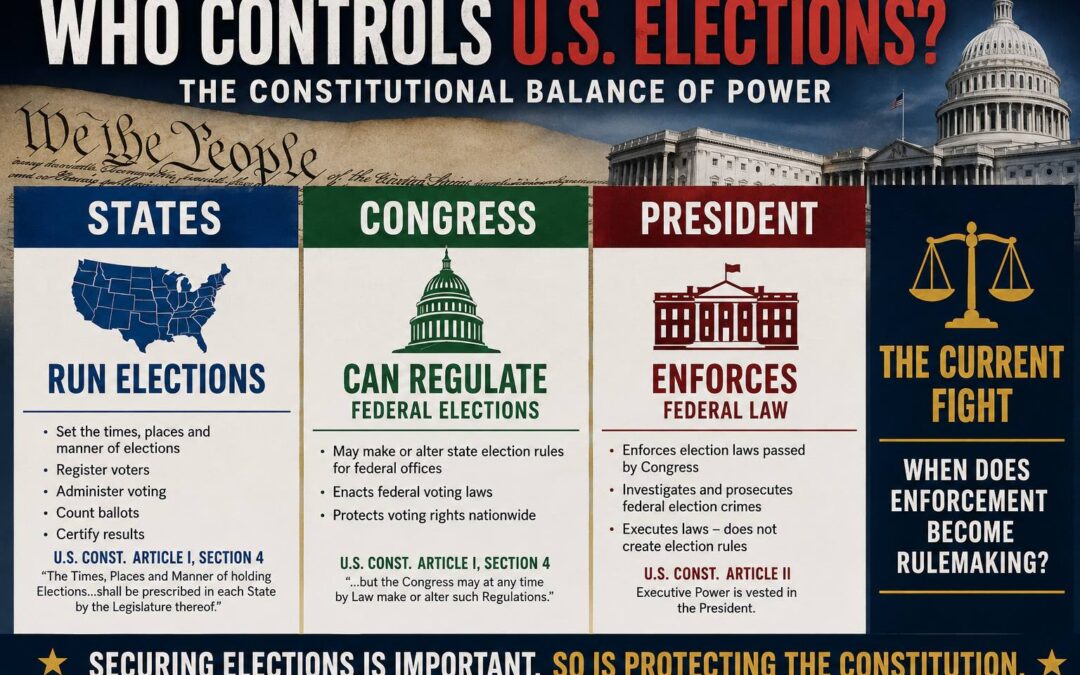
The Constitution gives states the first responsibility for running elections and gives Congress significant power to regulate federal elections. It does not give the president the same explicit authority. As the Trump administration expands federal involvement in voter rolls, citizenship checks and mail ballots before the 2026 midterms, that distinction is becoming one of the most important constitutional questions of the election.
The Trump administration says it is protecting American elections.
President Donald Trump’s March 31, 2026 executive order directs federal agencies to create citizenship-verification systems, examine voter eligibility, change procedures involving mail ballots and prioritize investigations of officials or organizations that distribute federal ballots to ineligible voters.
The stated goal is straightforward: prevent people who are not legally eligible from voting.
But there is another question Americans should be asking:
How much power should the federal executive branch have over elections that the Constitution largely assigns to states and Congress?
That question is becoming increasingly important because the administration’s response is much larger than simply prosecuting people who illegally vote.
Federal agencies are now involved in obtaining state voter rolls, comparing voter information against federal citizenship databases and attempting to establish nationwide requirements affecting mail ballots.
Some of that activity rests on federal laws passed by Congress.
Some of it is now being challenged as presidential overreach.
And federal courts have already intervened.
What This Means
The constitutional issue is not as simple as saying:
“Elections belong to the states.”
Nor is it accurate to say:
“The federal government controls federal elections.”
The Constitution divides election authority.
States
States generally establish and administer election procedures.
Congress
Congress has explicit constitutional authority to override or modify state rules governing congressional elections.
The president
The Constitution gives the president executive authority to enforce federal law, but it does not explicitly give the president the power to prescribe the times, places or manner of congressional elections.
That difference is at the center of the current legal fight.
What Does the Constitution Actually Say?
The starting point is Article I, Section 4 of the U.S. Constitution.
Known as the Elections Clause, it says:
“The Times, Places and Manner of holding Elections for Senators and Representatives, shall be prescribed in each State by the Legislature thereof; but the Congress may at any time by Law make or alter such Regulations.”
That sentence establishes something important.
The Constitution identifies two governmental actors responsible for regulating congressional elections:
State legislatures and Congress.
It does not mention the president.
The Congressional Research Service’s Constitution Annotated explains that states can create essentially a complete system for congressional elections, including:
- registration;
- supervision of voting;
- protection of voters;
- prevention of fraud;
- counting ballots;
- duties of election officials; and
- certification and publication of election results.
Congress, however, can override many of those state rules through federal legislation.
That federal authority is substantial.
The Supreme Court has repeatedly recognized it.
But notice what the Constitution requires:
Congress acts “by Law.”
That ordinarily means legislation passing the House and Senate and going through the constitutional lawmaking process.
An executive order is not legislation passed by Congress.
The President Does Have Election-Related Power — But It Is Different
Article II gives the president executive power.
That includes responsibility for enforcing laws Congress has enacted.
If Congress makes noncitizen voting a federal crime, for example, the Justice Department can investigate and prosecute violations.
That is normal executive authority.
President Trump’s March 31 executive order relies heavily on this argument.
The order says Article II imposes a federal responsibility to enforce criminal election laws and protect confidence in election outcomes.
It directs DHS, the Social Security Administration, DOJ and USPS to take various actions involving election eligibility.
That creates the constitutional dividing line:
Enforcing an election law Congress passed is one thing. Creating a new nationwide election procedure through executive action is another.
Courts are now deciding where Trump’s policies fall on that spectrum.
Presidential Elections Also Give States an Explicit Role
The Constitution also addresses presidential elections.
Article II says:
“Each State shall appoint, in such Manner as the Legislature thereof may direct,” its presidential electors.
The Supreme Court has historically described states’ authority over selecting presidential electors as extremely broad.
Again, the Constitution gives an explicit role to the states.
That does not mean the federal government has no authority.
Congress has enacted major federal voting laws under several constitutional powers, including laws protecting voting rights and establishing nationwide election-administration requirements.
But presidential control of election administration is a different constitutional proposition.
The Tenth Amendment Adds Another Layer
The Tenth Amendment says powers that the Constitution does not delegate to the federal government — and does not prohibit to the states — remain with the states or the people.
It should not be oversimplified.
Congress can unquestionably regulate many aspects of federal elections because the Constitution expressly gives Congress that authority.
The Tenth Amendment does not erase an enumerated congressional power.
But federalism still matters.
Where Congress has not authorized a particular action, the executive branch cannot simply assume unlimited authority because the policy involves federal elections.
That is why the current dispute is not merely about voter fraud.
It is about who gets to write election rules.
Where the Trump Administration Is Expanding Federal Involvement
Executive Order 14399 creates a significant new federal election infrastructure.
Among other things, it directs DHS and the Social Security Administration to compile a State Citizenship List for every state.
The lists are supposed to use federal citizenship, naturalization, Social Security and SAVE records.
The order requires the federal government to transmit those lists to state election officials at least 60 days before regularly scheduled federal elections.
It also directs DOJ to prioritize certain election investigations and authorizes agencies to pursue lawful withholding of federal funds from jurisdictions that fail to comply with applicable federal law.
The White House describes these actions as citizenship verification and election-security measures.
But the scale matters.
This is no longer simply a system for prosecuting individual people caught voting illegally.
It is federal infrastructure designed to examine eligibility across state election systems.
The Justice Department Is Already Seeking State Voter Rolls Nationwide
The Justice Department has aggressively sought statewide voter-registration records.
By April 2026, DOJ said it had sued 30 states and the District of Columbia over failures to provide voter-roll information.
Those cases have included states governed by both political parties.
That sounds like straightforward federal intrusion into state elections.
But here is where the constitutional analysis needs nuance.
DOJ argues that Congress already gave it this authority through laws including:
- the Civil Rights Act of 1960;
- the National Voter Registration Act; and
- the Help America Vote Act.
The Justice Department’s Office of Legal Counsel issued an opinion in May concluding that federal law permits DOJ to compel statewide voter-registration lists and share them with DHS for voter-fraud investigations and database cross-checking.
That means the voter-roll demands cannot simply be described as unconstitutional presidential overreach.
There is a genuine statutory argument that Congress already authorized federal oversight.
Whether courts ultimately agree with DOJ’s interpretation is another matter.
But CYS should distinguish this from actions where presidential authority is considerably less clear.
Mail Voting Is Where the Constitutional Question Becomes Much Sharper
Trump’s executive order also directed the U.S. Postal Service toward a new nationwide mail-ballot system.
The administration wants mail ballots connected to verified voter information and unique tracking identifiers.
The resulting USPS rule requires states to comply with new procedures involving voter lists, ballot envelopes and barcodes.
That is significant because ballot-envelope design and distribution are traditionally part of election administration.
And unlike DOJ enforcement of an existing federal statute, the president is attempting to change how election systems operate through executive action and a federal agency.
That is precisely why courts have intervened.
A Federal Judge Has Already Blocked the Mail-Ballot System
On August 28, U.S. District Judge Indira Talwani temporarily blocked significant portions of the USPS rule.
The judge found that states had raised serious claims that the rule was unlawful or unconstitutional and could disrupt election administration immediately before the midterms.
The requirements included providing voter information and using new barcode systems for ballot envelopes.
The Trump administration appealed.
As of September 3, the judge is considering whether to extend the prohibition while litigation continues.
This is important:
A temporary restraining order is not a final Supreme Court ruling that the president acted unconstitutionally.
But it is concrete evidence that the administration has moved far enough into traditional election administration for federal courts to find serious constitutional questions requiring intervention.
Why the Mail-Ballot Rule Raises a Separation-of-Powers Problem
Consider the structure of the Constitution.
It says:
States prescribe election procedures.
Then:
Congress may change them through law.
But the present policy was initiated by:
The president through executive order.
That is the fundamental constitutional concern.
If Congress passed a law requiring every mail ballot in a federal election to use a particular barcode system, Congress would have a strong Elections Clause argument supporting its authority.
Whether every detail of such a law survived other constitutional challenges would still need to be examined.
But Congress’s basic authority over federal-election procedure is explicitly stated in Article I.
The president does not possess an equivalent Elections Clause power.
That distinction matters.
Federal Power Over Elections Is Not Automatically Overreach
There is an important historical reason Congress has election authority.
The Framers did not want individual states to possess an unchecked ability to undermine the national government by refusing to conduct congressional elections properly.
That is why the Elections Clause allows Congress to override state election rules.
The Supreme Court has repeatedly held that Congress’s authority in this area can be broad.
Federal election laws therefore play legitimate roles.
Examples include laws dealing with:
- racial discrimination in voting;
- voter-registration procedures;
- accessibility;
- provisional voting;
- voting-system requirements;
- military and overseas voters; and
- preservation of election records.
So the constitutional question is not federal versus state in absolute terms.
It is:
Which part of the federal government is acting, and what constitutional or statutory authority allows it to act?
That’s the fine line.
Congress and the President Are Not Interchangeable
This distinction often gets lost in political debate.
“The federal government” consists of separate branches.
If the Constitution gives Congress authority to regulate congressional elections, that does not necessarily mean the president can exercise the same power independently.
Our constitutional structure intentionally separates those powers.
Congress writes laws.
The president executes them.
Courts determine whether government officials stay within constitutional and statutory limits.
The current election fight is testing whether the administration is merely executing existing law or effectively creating election law through federal agencies.
That is why these lawsuits matter.
The Scale Question Makes the Constitutional Question More Important
The administration says expanded federal action is necessary because noncitizen voting threatens election integrity.
Illegal noncitizen voting does occur.
But as CYS documented in our previous investigation, confirmed prosecutions remain relatively rare compared with the enormous number of votes cast in federal elections.
That doesn’t mean government should ignore illegal voting.
One illegal ballot is still illegal.
But government responses should be judged by both their effectiveness and their consequences.
A policy capable of affecting tens of millions of legal voters requires a correspondingly high level of accuracy and constitutional authority.
Consider the Difference in Scale
The documented problem involves relatively limited confirmed cases of illegal voting.
The administration’s solution includes:
Federal citizenship databases
Millions of voter records potentially examined.
Statewide voter-roll demands
DOJ litigation reaching most states.
Federal-state database cross-checking
State registrations compared with DHS and other federal records.
Mail-ballot regulation
Potential nationwide changes to the way ballots are distributed.
Election-official investigations
Federal prosecution prioritized for certain officials or organizations distributing ballots improperly.
Federal funding leverage
The executive order directs agencies to consider withholding federal money where existing law permits it.
That is a dramatic expansion in scale.
The question is not whether election integrity is legitimate.
It clearly is.
The question is whether every part of the response is legally authorized and proportionate.
Database Errors Make Federalization More Consequential
There is another reason scale matters.
Federal databases are not infallible.
A lawsuit filed this week challenges the administration’s use of federal citizenship databases on the grounds that outdated or inaccurate records could identify naturalized U.S. citizens as potential noncitizens.
State officials have also disputed some federal estimates about alleged noncitizens appearing on voter rolls.
This creates a fundamental election-integrity principle:
Government should not protect legitimate votes by creating a system that improperly blocks other legitimate votes.
A database system applied to millions of Americans can produce significant consequences even with a relatively small error rate.
That makes transparency, auditing and rapid correction procedures essential.
Timing Is Also Part of the Constitutional Concern
The first mail ballots for the midterms are already approaching distribution.
North Carolina is scheduled to begin sending ballots on September 4.
Meanwhile, states are still litigating what federal rules they must follow.
Election officials have argued that ballots, envelopes and election materials were designed and printed before the federal requirements were finalized.
The administration says the changes are modest and necessary.
Opponents say imposing new national procedures at this stage could create disruption.
Regardless of political perspective, changing election infrastructure immediately before voting begins creates obvious operational risk.
So Is This Federal Overreach?
Some of it may ultimately be found to be.
But accuracy requires separating three different categories.
Clearly legitimate federal authority
The federal government can prosecute federal election crimes.
Congress can regulate federal elections under powers explicitly granted by the Constitution.
Federal agencies can execute election laws that Congress validly enacted.
Disputed but potentially lawful federal authority
DOJ’s efforts to obtain voter rolls fall here.
The department argues existing federal statutes authorize those demands.
States and other challengers may dispute the scope of that authority.
Courts will determine where the statutory boundary lies.
The strongest executive-overreach concern
This involves presidential attempts to establish substantive election procedures through executive orders and federal agencies without new legislation from Congress.
The USPS mail-ballot system is the clearest current example.
A federal judge has already temporarily stopped its implementation because of serious legal and constitutional concerns.
The case is ongoing.
Why the Distinction Matters Beyond Donald Trump
This is bigger than one president.
Imagine a future Democratic president deciding through executive order that every state must:
- automatically mail ballots to every eligible voter;
- maintain a particular number of drop boxes;
- accept ballots for a federally determined period; or
- use a federal voter-registration system.
Republican-led states would almost certainly argue that the president had exceeded executive authority.
And they could have a legitimate constitutional argument.
The same constitutional limitation must apply regardless of which party occupies the White House.
That is the purpose of separation of powers.
Rules limiting government authority are most meaningful when they constrain officials we personally agree with.
The Constitution’s Election System Is Intentionally Divided
America does not have one national election authority.
Instead, election power is distributed.
States administer.
Congress can regulate federal elections.
Federal agencies enforce lawful federal statutes.
Courts resolve constitutional disputes.
That arrangement can be complicated.
But the complication is intentional.
It prevents any single institution from possessing complete control over the machinery that determines who governs the country.
The Bigger Question Before the 2026 Midterms
The Trump administration argues that the threat of illegal voting requires stronger federal action.
There is a legitimate case for accurate voter rolls, citizenship verification and prosecution of election crimes.
But Americans should examine not only the stated purpose of a government policy.
They should examine the power the policy creates.
Because once election authority moves somewhere new, that authority does not disappear when the administration changes.
The precedent remains.
So the question Americans should be asking before November 3 is not simply:
“Is illegal voting happening?”
It is also:
“Who should have the power to decide how our elections operate?”
The Constitution provides much of the answer.
States have substantial election authority.
Congress can override state procedures in federal elections through legislation.
The president can enforce federal election law.
But presidential authority to independently rewrite election procedures is much less clear — and current federal litigation suggests the Trump administration may be testing that constitutional boundary.
Frequently Asked Questions
Does the Constitution give states control over elections?
Yes, but not exclusive control.
Article I, Section 4 gives states the initial responsibility for determining the times, places and manner of congressional elections while allowing Congress to modify those rules through federal law.
Can Congress change state election rules?
Yes.
The Constitution explicitly gives Congress significant authority over House and Senate elections.
The Supreme Court has repeatedly recognized that power.
Can the president change election rules through an executive order?
That is much more legally disputed.
The Constitution does not give the president the same explicit Elections Clause authority it gives Congress.
The president can enforce federal laws, but courts are currently examining whether the Trump administration has crossed from enforcing existing law into creating election rules that require congressional legislation.
Has a court ruled Trump’s 2026 election policies unconstitutional?
A federal judge has temporarily blocked major elements of the administration’s USPS mail-ballot system after finding serious legal and constitutional concerns.
The litigation is ongoing, so it would be premature to describe the entire policy as finally adjudicated unconstitutional.
Is all federal involvement in elections unconstitutional?
No.
Congress has explicit constitutional authority over federal elections.
Federal laws including the Voting Rights Act, National Voter Registration Act and Help America Vote Act demonstrate legitimate federal involvement in election administration.
The constitutional question is often which federal branch is acting and under what authority.
The Bottom Line
The administration’s stated goal — preventing illegal votes — is legitimate.
But constitutional government requires more than a legitimate goal.
Government officials also need legitimate authority.
The Constitution gives states substantial responsibility for administering elections and gives Congress explicit power to regulate federal elections.
It gives the president authority to enforce federal law.
It does not plainly give the president an independent power to redesign election administration.
That is the line currently being tested.
And with voting in the 2026 midterms about to begin, Americans deserve to know not only whether election-security policies work, but whether the officials imposing them have the constitutional authority to do so.
Protecting elections means protecting them from illegal votes.
It also means protecting the constitutional limits on who controls them.
