
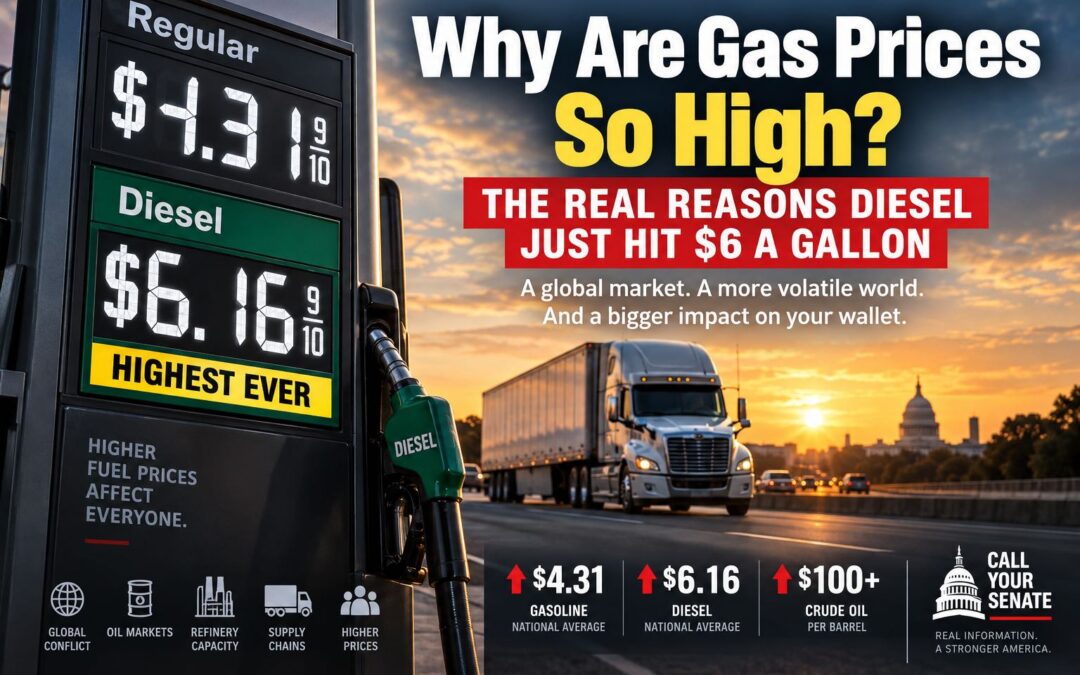
Diesel has crossed $6 a gallon nationally for the first time on record, while regular gasoline is above $4.30. The explanation is bigger than one president, one oil company or one policy. Here’s what is actually driving fuel prices—and what Washington can and cannot do about it.
Updated: September 13, 2026
The number on the gas-station sign is getting difficult to ignore.
The national average price for regular gasoline reached $4.31 per gallon as of September 12, according to AAA. A year earlier, it was about $3.19.
Diesel is experiencing an even more dramatic increase.
The national diesel average reached $6.16 per gallon, compared with about $3.70 one year earlier. AAA lists $6.16 as the highest recorded national diesel average in its data. Reuters separately reported that diesel crossed $6 nationally for the first time on record on September 10.
That means diesel has risen roughly 66% in a year.
And even if you never put diesel into your own vehicle, you may eventually pay for that increase.
Diesel powers much of the trucking, farming, construction and freight infrastructure that moves goods through the American economy. Sustained increases can eventually work their way into transportation charges and the prices consumers pay for groceries, furniture, vehicles and other goods.
So what is actually happening?
The answer is more complicated than the political arguments circulating online.
Gas prices are being pushed by a combination of higher crude-oil prices, disruptions in global oil shipping, unusually tight diesel supplies, refinery economics, attacks affecting Russian refining capacity and a global petroleum market that connects American fuel prices to events thousands of miles away.
And there is an important fact complicating the political debate:
The United States is simultaneously on track to produce more crude oil than ever before.
Understanding how both things can be true explains a lot about how gasoline prices actually work.
Gas and Diesel Prices: Then vs. Now
According to AAA’s September 12 national averages:
| Fuel | One Year Ago | Sept. 12, 2026 | Change |
|---|---|---|---|
| Regular gasoline | $3.19 | $4.31 | +$1.12 |
| Diesel | $3.70 | $6.16 | +$2.46 |
AAA also reports that regular gasoline rose from about $4.15 to $4.31 in only one week.
That increase is happening at an unusual time.
Gasoline prices often decline after the summer driving season as demand falls and refiners transition away from more expensive summer gasoline blends. Instead, prices have been moving higher. AAA reported on September 10 that gasoline demand had actually declined while domestic gasoline supplies increased—yet pump prices still climbed sharply.
That is an important clue.
The current price increase isn’t simply Americans suddenly driving more.
Why Are Gas Prices So High Right Now?
There isn’t one cause.
There are several.
1. Oil is back around $100 a barrel
Crude oil remains one of the largest components of what consumers pay for gasoline.
The U.S. Energy Information Administration, or EIA, explains that a gallon of gasoline ultimately reflects four major categories:
Crude oil + refining + distribution/marketing + taxes.
Crude oil is typically the largest component.
And crude prices have risen sharply.
On September 11, Brent crude settled at $104.61 per barrel, while U.S. West Texas Intermediate settled at $100.05. Reuters reported that oil remained on track for a weekly increase of more than 8% amid concerns about global supply disruptions.
When crude becomes significantly more expensive, refiners have to pay more for the primary ingredient used to manufacture gasoline and diesel.
Eventually, much of that increase reaches the pump.
But crude oil is only part of the current story.
2. One of the world’s most important oil routes is under pressure
If you’ve been hearing about the Strait of Hormuz, there is a reason.
The narrow waterway between Iran and Oman is one of the most important energy transportation routes on Earth.
According to EIA data, approximately 20.9 million barrels of oil per day moved through the Strait of Hormuz during the first half of 2025.
That was equivalent to roughly 20% of global petroleum-liquids consumption and approximately one-quarter of the world’s maritime-traded oil.
There is not enough alternative pipeline capacity to simply reroute all of that oil if shipping through the strait is significantly disrupted.
That makes Hormuz a global economic pressure point.
Throughout 2026, disruptions associated with the Middle East conflict have reduced normal flows of crude oil and petroleum products through the region.
And the situation remains volatile.
Reuters reported September 13 that new attacks involving Saudi energy infrastructure and shipping in the Gulf were again threatening supplies, with traders expecting renewed upward pressure when oil markets reopened.
This doesn’t mean every gallon of American gasoline came through Hormuz.
It didn’t.
It means disruption to a route responsible for roughly one-fifth of global petroleum consumption can change the world price of oil.
And American buyers participate in that world market.
But Doesn’t America Produce Its Own Oil?
Yes.
In fact, this is one of the most important facts in the entire discussion.
The United States is on track for record oil production in 2026.
The EIA currently forecasts U.S. crude production will average approximately 13.8 million barrels per day in 2026, exceeding the previous annual record of 13.7 million barrels per day set in 2025.
Weekly EIA data showed domestic production approaching 13.95 million barrels per day in early September.
So how can the United States produce record amounts of oil while Americans are paying more than $4 for gasoline?
Because the United States is not an isolated oil economy.
Oil is traded globally.
American oil producers sell into markets influenced by global supply and demand.
American refiners also buy crude and sell gasoline, diesel and other petroleum products into interconnected markets.
When a major source of international supply is disrupted, global buyers look elsewhere.
That includes the United States.
During the Middle East disruptions earlier this year, U.S. petroleum exports reached a record 13.6 million barrels per day in April, according to the EIA.
Crude-oil exports reached 5.6 million barrels per day, while distillate exports—including fuels such as diesel—reached approximately 1.6 million barrels per day.
This is why the statement:
“America produces plenty of oil, so overseas events shouldn’t affect our gas prices”
doesn’t accurately describe how the market works.
More U.S. production can increase supply and put downward pressure on prices.
But American oil and refined products still participate in a global market.
Why Is Diesel Even More Expensive?
This is where the current energy story becomes particularly important.
Diesel isn’t simply experiencing the same problem as gasoline.
It has additional problems of its own.
The EIA expects U.S. inventories of distillate fuel oil—the category that includes diesel—to fall below 100 million barrels in September and remain below the five-year seasonal low through the end of 2026 and much of 2027.
At the same time, international disruptions have increased demand for refined products produced by American refineries.
And Russian refining capacity has also been disrupted.
Reuters reported that the combination of the Iran war and Ukrainian attacks on Russian refineries helped push U.S. diesel above $6.
That creates a problem different from simply asking:
“Do we have enough crude oil?”
You can have crude oil and still have a shortage—or tight supply—of the particular refined product consumers need.
Think of it this way:
Crude oil is the ingredient.
Diesel is the finished product.
Having plenty of wheat does not automatically mean there is plenty of bread if bakery capacity becomes constrained.
Oil markets can work similarly.
The Refinery Problem Most People Never Hear About
Another term has become increasingly important in 2026:
Crack spread.
Despite the unusual name, the idea is straightforward.
A crack spread is essentially an indicator of the difference between the cost of crude oil and the wholesale value of the refined fuels produced from it.
When gasoline or diesel becomes scarce relative to crude oil, those spreads can rise.
And right now, they are elevated.
The EIA says higher crude prices and elevated refinery margins are both contributing to higher prices at the pump.
For diesel, the situation is particularly severe.
The EIA estimates average U.S. diesel crack spreads will exceed $2 per gallon from August through November 2026 before declining under its baseline forecast.
That means today’s diesel problem isn’t merely:
“Oil costs more.”
It is also:
“Turning available oil into the diesel demanded by the world has become much more valuable.”
American Refineries Are Already Running Hard
Another common suggestion is:
Why don’t refineries simply produce more?
They are.
EIA data for the week ending September 4 showed U.S. refinery utilization at approximately 97.8% of operable capacity.
The previous week it was approximately 98%.
That’s extremely high utilization.
This matters because it demonstrates the limits of treating the problem as if there were an enormous amount of idle refining capacity that could immediately be switched on.
Refineries also periodically need maintenance, and the EIA expects normal fall refinery maintenance to reduce distillate production at the same time agricultural harvest season increases diesel demand.
That combination can keep diesel markets tight.
Why Should You Care About $6 Diesel If Your Car Uses Gasoline?
Because diesel doesn’t just move diesel cars.
It moves America’s supply chain.
Diesel powers or supports:
- Tractor-trailers
- Agricultural equipment
- Construction equipment
- Freight transportation
- Some rail operations
- Industrial machinery
- Delivery networks
CBS News reports that sustained diesel increases could eventually affect consumer prices as businesses renegotiate transportation contracts and begin paying higher fuel surcharges. Food that must be refrigerated and transported long distances may be particularly exposed.
Imagine a head of lettuce.
It may be harvested using diesel-powered agricultural equipment.
A truck moves it from the farm.
Another transportation network moves it through distribution.
A refrigerated truck delivers it to a grocery store.
Each step has a cost.
When transportation costs rise significantly and remain elevated, businesses eventually have three basic options:
Absorb the cost.
Reduce another cost.
Pass some of it to the customer.
That is why the $6 diesel milestone matters even to Americans who have never owned a diesel vehicle.
Is $6 Diesel Going to Cause More Inflation?
It could add inflationary pressure, particularly if prices remain elevated.
But there is an important distinction.
A sudden fuel spike doesn’t automatically mean every product becomes dramatically more expensive tomorrow.
Many large businesses operate under transportation contracts negotiated months in advance. Others can temporarily absorb increased costs.
The longer diesel remains expensive, however, the greater the possibility that those costs begin appearing elsewhere.
GasBuddy analyst Patrick De Haan told CBS News that if elevated diesel prices persist beyond roughly six weeks, the effects are more likely to begin working through large commercial fuel buyers and eventually consumers.
So the more useful question isn’t simply:
“Did diesel hit $6?”
It’s:
“How long does diesel stay near $6?”
Who Actually Controls Gas Prices?
This is where the political conversation frequently becomes misleading.
Gas prices are often treated as if there were a dial inside the Oval Office.
There isn’t.
But that doesn’t mean government policy is irrelevant either.
The truth sits between those extremes.
Does the president control gas prices?
No president directly sets the national market price of gasoline or diesel.
But presidents can influence conditions that affect prices through policies involving:
- Foreign relations and military policy
- Sanctions
- Federal oil and gas leasing
- Environmental regulation
- Pipeline and infrastructure decisions
- Emergency authorities
- The Strategic Petroleum Reserve
- Trade policy
- Diplomatic relationships with oil-producing countries
Some presidential actions can affect supply expectations immediately.
Others may take years to materially affect production.
And many global events remain outside any president’s direct control.
What Can Congress Control?
Congress has substantial energy-policy authority as well.
Congress can legislate policies involving:
- Federal energy taxes
- Oil and gas leasing
- Pipeline permitting
- Refinery regulation
- Environmental requirements
- Strategic petroleum reserves
- Fuel standards
- Transportation policy
- Sanctions
- International trade
- Antitrust law
- Energy infrastructure
Congress also determines the federal gasoline and diesel excise taxes.
As of January 2026, the federal gasoline tax was 18.4 cents per gallon, while the federal diesel tax was 24.4 cents per gallon.
Average state taxes were approximately 33 cents per gallon on gasoline and 35.5 cents on diesel, before certain local taxes and fees.
Those taxes matter.
But they also clearly do not explain a $2.46 year-over-year increase in the national diesel price.
Are Oil Companies Responsible?
Oil companies are part of the system, but this question also requires nuance.
Producers decide whether to drill, invest and expand production.
Refiners determine how facilities operate and which petroleum products they produce.
Companies make those decisions partly in response to expected profits, regulations, capital costs and market prices.
Refining profits can also increase substantially when refined fuels become scarce.
But the current situation cannot be explained solely by saying oil companies suddenly decided to charge Americans more.
There are measurable global supply disruptions occurring simultaneously.
The EIA specifically identifies international supply disruptions, higher crude prices and elevated refinery margins as contributing factors.
The more accurate explanation is that oil companies operate inside—and respond to—the same global market experiencing those disruptions.
So Who Deserves the Blame?
Probably not one person.
That may be politically unsatisfying.
But it is economically more accurate.
Today’s fuel prices reflect a combination of:
War and geopolitical instability
Disrupted shipping through major energy routes
Damage to global refining capacity
Tight diesel inventories
Strong international demand for U.S. refined products
Higher crude-oil prices
Refinery economics
Taxes
Distribution costs
Domestic energy policy
And the decisions of governments and companies around the world.
Some of those factors are influenced by the current administration.
Some were shaped by previous administrations and Congresses.
Some are decisions made by private companies.
Some are decisions made by foreign governments.
And some are consequences of wars that have disrupted a global commodity market.
Reducing all of that to “the president controls gas prices”—regardless of which party controls the White House—doesn’t help voters understand the problem.
Then Why Do Presidents Take Credit When Gas Prices Fall?
Because politicians understand something very well:
Gas prices are visible.
Americans don’t check the federal deficit every morning.
They don’t see Treasury yields while driving to work.
But millions of Americans drive past a giant illuminated sign displaying the price of gasoline.
When that number falls, politicians have an incentive to claim credit.
When it rises, opponents have an incentive to assign blame.
The economic reality is much less convenient.
A president may implement policies that influence energy costs.
But crude oil, refining, global demand, wars, OPEC+ production, shipping disruptions and market expectations can overwhelm domestic policy—sometimes very quickly.
The same standard should apply regardless of which party occupies the White House:
Give elected officials credit for policies they actually control. Hold them accountable for decisions they actually make. But don’t pretend they control things they don’t.
What’s Happening Right Now Is Particularly Unusual
There is another piece of data worth paying attention to.
American oil production isn’t collapsing.
It’s setting records.
American refineries aren’t sitting mostly idle.
They’re operating near capacity.
Gasoline demand recently declined.
Gasoline inventories recently increased.
And yet fuel prices are rising.
Taken together, those facts point strongly toward the importance of global crude markets, international supply disruptions and refining constraints in the current price spike.
That’s what makes this moment different from the simple political narratives circulating online.
What Happens Next?
There are reasons for both optimism and concern.
The EIA currently expects diesel refinery margins to gradually decline during 2027.
But that forecast depends on an important assumption:
More normal tanker traffic through the Strait of Hormuz.
The agency explicitly warns that if Middle Eastern petroleum flows remain constrained beyond the end of 2026, global distillate margins could remain higher than its current forecast.
And developments this weekend demonstrate just how uncertain that assumption remains.
Reuters reported September 13 that additional attacks involving shipping and Saudi energy infrastructure were again raising fears of worsening supply disruptions.
In other words:
The direction of your next tank of gasoline may depend partly on events occurring thousands of miles from the gas station where you buy it.
Three Numbers to Watch
If you want to understand where gasoline and diesel prices may go next, watch these three things.
1. Crude oil prices
If Brent and WTI remain around or above $100, that creates continued pressure on gasoline.
2. The Strait of Hormuz
More normal shipping could relieve pressure. Additional disruptions could do the opposite.
3. Diesel inventories and refinery margins
Diesel could remain unusually expensive even if crude prices moderate if global refined-product supplies remain tight.
Those indicators tell us far more about the direction of fuel prices than a campaign speech.
The Bigger Question: What Is Washington Going to Do About It?
Gas prices are ultimately determined by markets.
But elected officials still make choices.
Congress can debate energy production.
Congress can debate refinery and infrastructure policy.
Congress can examine fuel exports.
Congress can change taxes.
Congress can consider emergency measures.
Congress can scrutinize market competition.
Congress can debate sanctions and trade.
Congress can oversee the administration’s energy policies.
And senators can explain what they believe the federal government should—and should not—do.
So instead of asking only:
“Whose fault are gas prices?”
Ask your senators something more useful:
What specific action do you support to reduce gasoline and diesel costs?
How quickly would that policy actually affect prices?
What would it cost taxpayers?
Would it increase domestic supply, refining capacity or both?
Would you support restricting U.S. fuel exports during a domestic price emergency?
What is your plan if disruptions in the Strait of Hormuz continue?
Those questions are harder to answer with a slogan.
And that’s the point.
Take the Next Step
Ask Your Senators About Fuel Costs
Congress can act on energy production, refinery policy, fuel exports, taxes, sanctions and market oversight. Find your senators and ask which specific steps they support—and how quickly those steps could affect gasoline and diesel prices.
Call Your Senate provides nonpartisan explanations of federal government, legislation and elections so Americans can understand what Washington is doing—and participate in what happens next.
Frequently Asked Questions
Why are gas prices so high in 2026?
Gasoline prices are being affected by higher crude-oil prices, disruptions to global petroleum flows through the Strait of Hormuz, elevated refinery margins and broader geopolitical instability. Brent crude returned above $100 per barrel in September, while gasoline prices have risen even as recent U.S. gasoline demand declined.
Why is diesel over $6 a gallon?
Diesel supplies are unusually tight globally. Middle East petroleum disruptions, damage to Russian refineries, low U.S. distillate inventories and strong international demand for refined products have contributed to record U.S. diesel prices.
Is $6 diesel a record?
Yes. AAA reported a national diesel average of $6.1602 on September 12, 2026, its highest recorded average. Reuters reported that the U.S. average crossed $6 for the first time on September 10.
Does the president control gas prices?
No president directly sets gasoline prices. Presidential decisions can influence energy supply, sanctions, regulation, federal leasing, strategic reserves and foreign policy, but gasoline prices are also heavily influenced by global crude prices, refinery conditions, international supply and demand, taxes and distribution costs.
If America produces record amounts of oil, why is gas expensive?
Because oil is traded in a global market. The United States can simultaneously produce record quantities of crude oil while global disruptions increase the market price paid by refiners. U.S. crude and petroleum products are also exported internationally.
Why does the Strait of Hormuz affect American gas prices?
Approximately one-fifth of global petroleum liquids consumption historically moves through the Strait of Hormuz. A major disruption can reduce available global supply and raise international crude and petroleum-product prices even though the United States imports relatively little of its own petroleum through the strait.
Will high diesel prices make groceries more expensive?
Potentially. Trucks, agricultural equipment and other parts of the food supply chain use diesel. If elevated fuel costs persist long enough, businesses may pass some transportation and production costs to consumers.
What makes up the price of a gallon of gas?
The major components are crude oil, refining costs and profits, distribution and marketing costs, and federal, state and local taxes.
Sources & Further Reading
Primary data for this article comes from the U.S. Energy Information Administration and AAA, supplemented by Reuters reporting on current international energy-market disruptions.
U.S. Energy Information Administration: gasoline and diesel price components, refinery utilization, crude production, petroleum exports, distillate inventories and Strait of Hormuz data.
AAA: current national gasoline and diesel retail-price averages.
Reuters: current reporting on Middle East shipping disruptions, Russian refinery disruptions and record U.S. diesel prices.
CBS News: reporting and expert analysis on how sustained diesel-price increases can move through consumer supply chains.
Prices and market conditions can change rapidly. Figures in this article reflect the latest data available at publication on September 13, 2026.
