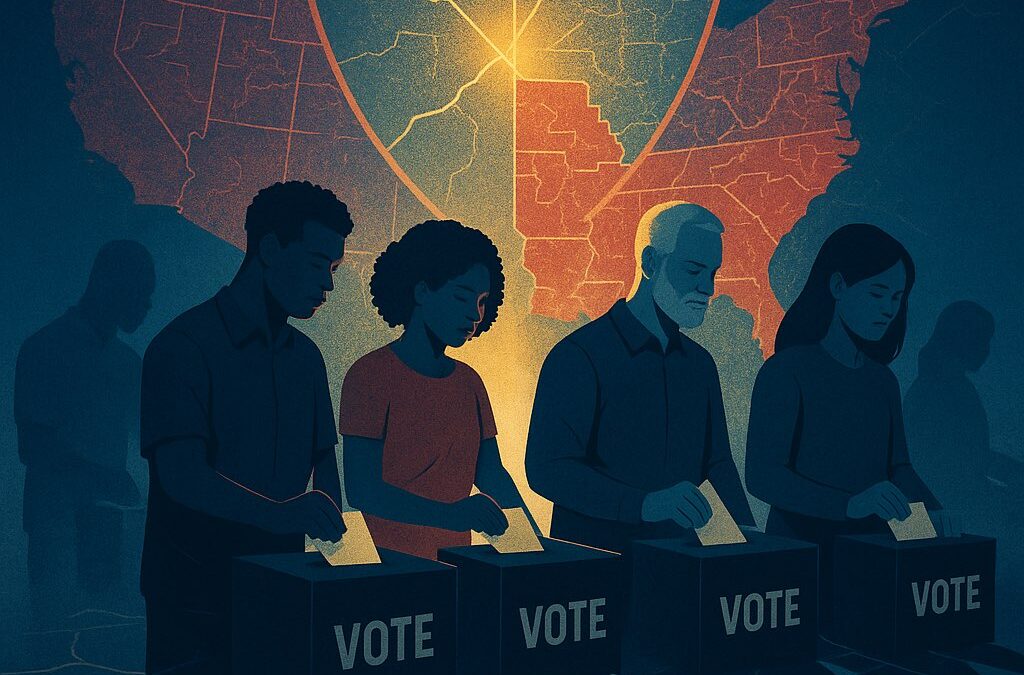
A critical case before the Supreme Court threatens to undermine one of the last major safeguards against racial discrimination in voting.
On October 15, 2025, the Supreme Court heard oral arguments in *Louisiana v. Callais*, a case that could fundamentally change how Americans are protected from discriminatory voting practices. While the Court isn’t technically removing Section 2 of the Voting Rights Act from the books, the conservative majority appears ready to significantly limit how this crucial protection can be used.
What Is Section 2?
Section 2 of the Voting Rights Act is the primary legal tool that allows citizens to challenge racially discriminatory election practices. For decades, it has served as a guardrail against tactics like “packing” Black voters into a small number of districts or “cracking” communities of color by splitting them across multiple districts. Both strategies aim to dilute the political power of minority voters.
Think of Section 2 as the last line of defense. When states draw voting maps or implement election rules that discriminate against voters based on race, Section 2 gives people the power to take those cases to court and fight back.
Why This Case Matters
The Supreme Court’s decision in this case could effectively weaken Section 2 to the point where it becomes difficult or impossible to use. This would leave communities of color with few tools to challenge discriminatory voting practices.
The timing is particularly concerning. In 2013, the Supreme Court gutted Section 5 of the Voting Rights Act in the Shelby County decision. Section 5 had required certain states with histories of discrimination to get federal approval before changing their voting laws. After that protection was removed, many jurisdictions quickly moved to implement discriminatory changes. If Section 2 is weakened now, there will be almost no federal protection left.
The Real-World Impact
If the Supreme Court sides with Louisiana and limits Section 2, the consequences would be immediate and far-reaching:
- More Gerrymandering: Voting rights groups estimate that GOP-controlled states could redraw at least 19 more congressional districts in favor of Republicans. Louisiana alone would likely redraw its maps to reduce the number of majority-minority districts from two back down to one before the 2026 midterms, giving Republicans an additional seat in Congress.
- Loss of Political Power: Black communities and other communities of color would lose significant political representation. When people lose representation, their concerns get sidelined. Issues that matter to these communities, from healthcare to education to criminal justice reform, would have fewer champions in government.
- Weakened Democracy: Fair representation isn’t just about one group or another. When any community loses the ability to have their voices heard equally, democracy itself becomes weaker. The principle of “one person, one vote” rings hollow when district maps are drawn to predetermine outcomes.
Who Gets Hurt Most?
The impact would hit hardest in Southern states where Republicans control the legislature and where voting patterns are racially polarized. Communities of color, particularly Black voters in these states, would face the most significant loss of political power.
History shows us what happens when these protections disappear. The 1982 amendments to Section 2 led to transformative changes, especially in the South. Hundreds of cities, towns, and counties ended discriminatory at-large election systems that had locked out minority voters. All of those gains could now be at risk.
What You Can Do
This is where your voice matters. Your senators will play a crucial role in any legislative response to this Supreme Court decision. They need to hear from you about why voting rights protections matter.
Call your senators. Tell them that Section 2 of the Voting Rights Act must be protected. Let them know that if the Supreme Court weakens these protections, Congress must act to restore them.
Democracy works best when everyone has an equal voice. Right now, that fundamental principle is under threat. The question is: will we fight to protect it?
Stay informed about this case and other voting rights issues. The Supreme Court’s decision in Louisiana v. Callais is expected in 2025. Your voice, your vote, and your advocacy matter now more than ever.
Sources
- Democracy Docket. “LIVE BLOG: Supreme Court Hears Case That Could Gut the Voting Rights Act.” October 15, 2025. https://www.democracydocket.com/news-alerts/live-blog-supreme-court-hears-case-that-could-gut-the-voting-rights-act/
- American Civil Liberties Union. “Live Coverage: Louisiana v. Callais SCOTUS arguments.” October 15, 2025. https://www.aclu.org/news/voting-rights/live-coverage-louisiana-v-callais-scotus-arguments
- NPR. “A Supreme Court ruling on voting rights could boost Republicans’ redistricting efforts.” October 15, 2025. https://www.npr.org/2025/10/15/nx-s1-5567801/supreme-court-louisiana-redistricting-voting-rights-act
- Center for American Progress. “Louisiana v. Callais: The End of the Voting Rights Act?” October 2025. https://www.americanprogress.org/article/louisiana-v-callais-the-end-of-the-voting-rights-act/
- NAACP Legal Defense and Educational Fund. “Louisiana v. Callais FAQ.” February 24, 2025. https://www.naacpldf.org/case-issue/louisiana-v-callais-faq/
- Brennan Center for Justice. “Louisiana v. Callais.” https://www.brennancenter.org/our-work/research-reports/louisiana-v-callais
- Balls and Strikes. “Louisiana v Callais: The Republicans Justices Are Getting Ready to Finish Off the Voting Rights Act.” October 13, 2025. https://ballsandstrikes.org/scotus/louisiana-v-callais-supreme-court-oral-argument-preview-roberts/
- JURIST. “Louisiana v. Callais: Supreme Court to Weigh Louisiana Redistricting Case Pitting Voting Rights Act Against Equal Protection.” October 15, 2025. https://www.jurist.org/features/2025/10/14/louisiana-v-callais-supreme-court-to-weigh-louisiana-redistricting-case-pitting-voting-rights-act-against-equal-protection/

