

What’s Going On
The U.S. Treasury, under the Trump administration, has extended a $20 billion currency-swap line to help stabilize Argentina’s struggling economy. (ABC News) At the same time, it’s raising Argentina’s low-tariff beef import quota to 80,000 metric tons—a four-fold rise—allowing more Argentine beef into the U.S. market. (Reuters) Supporters call the move a smart blend of foreign-policy and market relief; critics—especially U.S. ranchers—say it could undercut domestic producers at a fragile time. (AP News)
Key Facts
- Argentina’s economy has been under severe pressure: high inflation, currency instability, and debt strains. U.S. officials say stabilizing Argentina, a major regional economy, is strategically important and could foster reforms and investment. (Politico)
- Argentina is now eligible to export beef to the U.S. under previously established food‐safety standards.
- The beef quota increase means Argentina can send more beef to the U.S. at lower tariffs, but even at 80,000 metric tons it remains a small share of U.S. annual beef supply. (Newsweek)
- U.S. cattle herds are the smallest they have been in decades, which is a major driver of high beef prices nationwide. (AP News)
Why the Beef Quota Matters
By increasing low-tariff imports from Argentina, the administration aims to moderate record U.S. beef prices. Examples:
- Retail beef prices in grocery stores have surged, partly because U.S. ranchers are raising fewer cattle.
- Processing plants and restaurants may use “lean” imported beef or trimmings from abroad, which could moderately reduce their input costs.
- But: Even after the quota expansion, Argentine supplies still represent a very small slice of U.S. beef consumption. Experts say effects on grocery-case prices are likely minimal or gradual. (AP News)
A Complicated Moment for U.S. Ranchers
This decision hits close to home for the very group that helped elect this administration. Rural America and agricultural states overwhelmingly backed President Trump in past elections, drawn to his promises of “America-First” trade policies and support for farmers.
Now, many of those same producers are questioning a policy that invites more foreign competition during a time when domestic ranchers are struggling to rebuild herds.
Groups like the National Cattlemen’s Beef Association (NCBA) have expressed concern that expanding imports—especially from South America—could harm local producers who face higher feed, labor, and regulatory costs. (Farm Policy News)
What This Means for You
- At the grocery store: Don’t expect a dramatic drop in beef prices. These additional imports may soften some wholesale costs, but the core issue is tight U.S. cattle supply.
- Dining out: Some large food-service buyers (burger chains, etc.) may experience cost relief and could slow menu-price increases—but broad cuts are unlikely.
- Ranchers and farmers: Domestic cattle producers are under pressure. With fewer cattle in the U.S., added import competition can be a headwind for U.S. producers, especially smaller family farms.
- Taxpayer/Policy risk: While technically a swap and not a cash grant, the $20 billion support to Argentina does mean the U.S. is backing Argentina’s stabilization. Supporters argue it’s strategic; critics say it may be a mis-prioritization when American farmers feel overlooked. (ABC News)
The Bigger Picture
For everyday Americans, this is a story about how U.S. foreign-economic policy ties into something as basic as what you pay for a steak. It also highlights the tension between global-economic diplomacy, domestic agricultural health, and consumer-cost pressures.
By understanding the links between trade, foreign-aid and supply chains, citizens can better ask:
- Should U.S. policy focus more on bolstering domestic ranching and supply?
- How much leverage do import quotas and trade deals truly have on retail prices?
- What safeguards exist when large foreign-currency deals are made in an election year?
Bottom Line
The quota increase for Argentine beef and the U.S.’s economic backing of Argentina may have some ripple-effects—especially in food-service and wholesale markets—but for the average consumer walking into the grocery store today, it’s unlikely to bring dramatic price relief. The larger issue remains the tight U.S. cattle supply. As this situation evolves, transparency around U.S. trade policy, agricultural strategy, and consumer impact will be increasingly important.
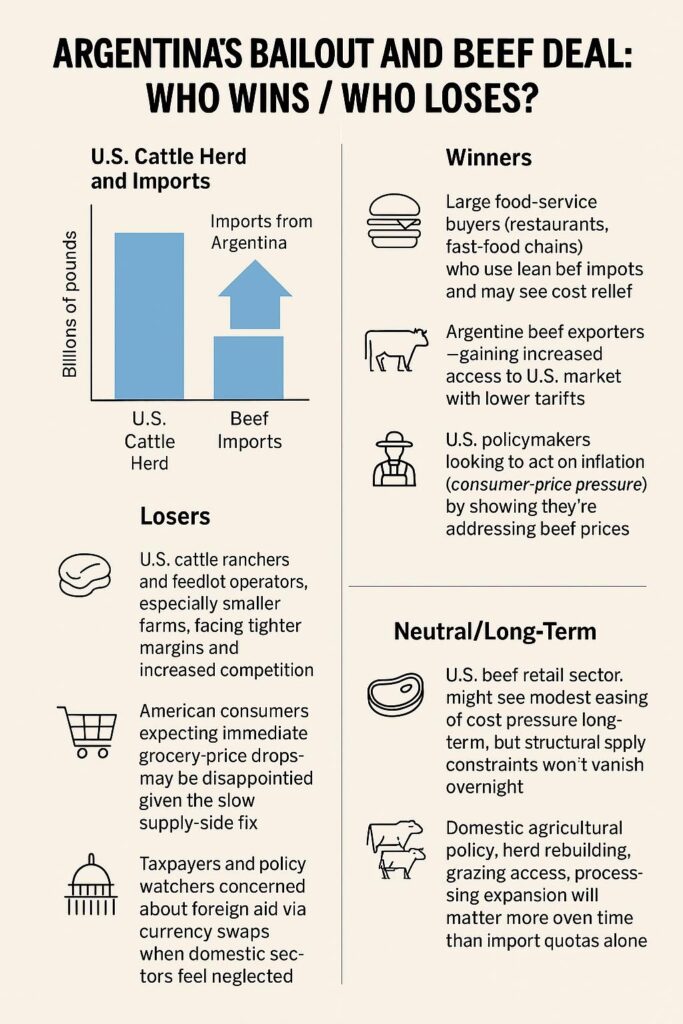
Who Wins / Who Loses?
Winners
- Large food-service buyers (restaurants, fast-food chains) who use lean beef imports and may see cost relief.
- Argentine beef exporters — gaining increased access to U.S. market with lower tariffs.
- U.S. policymakers looking to act on inflation (consumer-price pressure) by showing they’re addressing beef prices.
Losers
- U.S. cattle ranchers and feedlot operators, especially smaller farms, facing tighter margins and increased competition.
- American consumers expecting immediate grocery-price drops—may be disappointed given the slow supply-side fix.
- Taxpayers and policy watchers concerned about foreign aid via currency swaps when domestic sectors feel neglected.
Neutral/Long-Term
- U.S. beef retail sector: might see modest easing of cost pressure long-term, but structural supply constraints won’t vanish overnight.
- Domestic agricultural policy: herd rebuilding, grazing access, processing expansion will matter more over time than import quotas alone.
Sources
- “What to know about the Trump administration’s $20 B bailout for Argentina.” ABC News, Oct. 15 2025. Link (ABC News)
- “US buys Argentine pesos, finalizes $20 billion currency swap.” Associated Press, Oct. 9 2025. Link (AP News)
- “Trump quadrupling Argentina beef tariff‐rate quota to 80,000 metric tons.” Reuters, Oct. 23 2025. Link (Reuters)
- “US ranchers oppose Trump’s plan to import more Argentine beef and experts doubt it will lower prices.” AP News, Oct. 21 2025. Link (AP News)
- Additional context on import share and commentary: Newsweek, Oct. 23 2025. Link (Newsweek)
