
The war involving the United States, Israel and Iran is no longer confined to missile strikes, military bases or Iranian nuclear facilities.
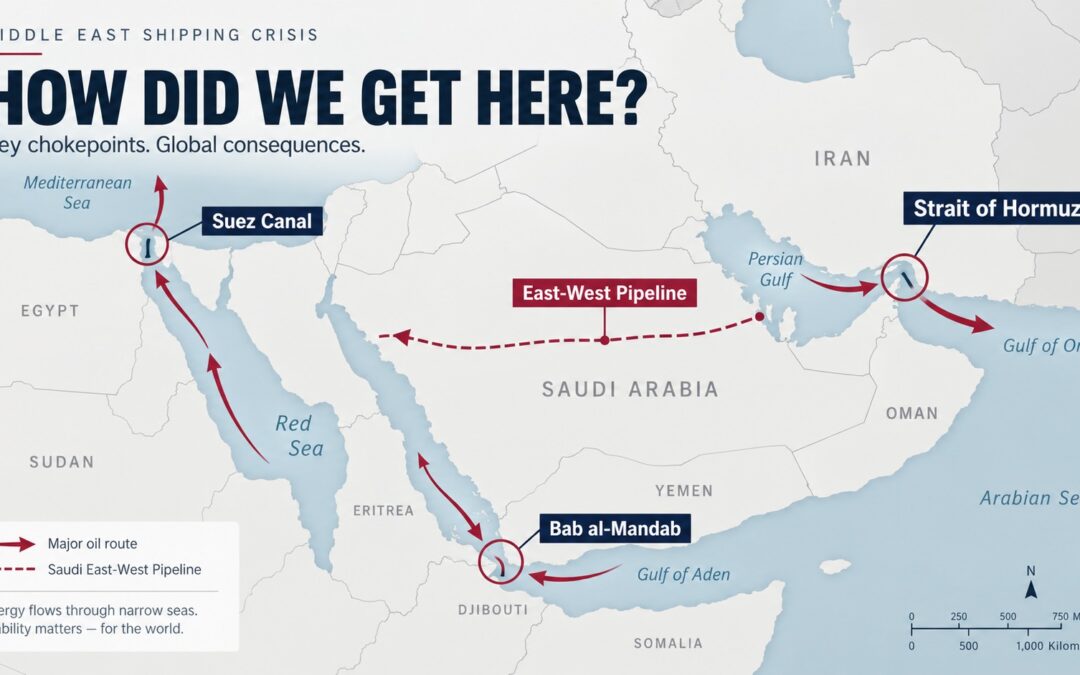
Its effects now stretch across the Persian Gulf, Yemen, Saudi Arabia, the Red Sea and two of the most important shipping routes on Earth. Oil prices remain above $100 a barrel, U.S. diesel prices have climbed sharply, shipping through the Strait of Hormuz remains disrupted, and fighting around Yemen is threatening another route used to move energy and goods between Asia, Europe and the United States.
The Congressional Budget Office now estimates that U.S. military operations against Iran had cost the Defense Department roughly $38 billion through August 1, with the conflict costing an estimated $2 billion to $3 billion for each additional month, depending on the intensity of fighting. CBO also concluded that disruptions to oil and natural-gas shipments are contributing to higher gasoline, diesel, transportation and consumer prices in the United States.
But understanding how the United States reached this point requires going back before the latest attacks.
The conflict did not begin because Iran suddenly closed the Strait of Hormuz.
It did not begin because the Houthis suddenly moved toward Bab al-Mandab.
Those developments came after a sequence of diplomatic disputes, military escalations and decisions spanning several years — including active nuclear negotiations that were still underway shortly before the current war began.
What Is Happening Right Now?
There are currently several interconnected fronts.
The Strait of Hormuz
Iran sits along the northern side of the Strait of Hormuz, the narrow entrance to the Persian Gulf.
It is one of the world’s most important energy corridors because oil and liquefied natural gas from Saudi Arabia, Iraq, Kuwait, Qatar, the United Arab Emirates and Iran traditionally move through it.
The U.S.-Iran war has sharply disrupted that traffic. Although some shipping has resumed and U.S. forces have attempted to keep the route open, maritime traffic remains below normal levels and the threat of attacks continues.
That disruption matters directly to Americans because restricting oil supply pushes global energy prices higher.
Yemen and Bab al-Mandab
At the opposite end of the Arabian Peninsula, the Iran-aligned Houthi movement has expanded its position along Yemen’s Red Sea coastline.
The Houthis recently captured strategically important territory around Bab al-Mandab, the narrow strait connecting the Red Sea with the Gulf of Aden and Indian Ocean.
Their advances now threaten another major route used by commercial vessels traveling toward the Suez Canal.
Fighting has intensified as Saudi and Yemeni forces attack Houthi positions. The United Nations says the renewed fighting has displaced more than 100,000 people.
Saudi Arabia’s oil bypass is also under pressure
Saudi Arabia has another way to move oil without using Hormuz.
Its East-West Pipeline carries oil across Saudi territory to the Red Sea.
That pipeline became considerably more important after traffic through Hormuz declined.
But it, too, has now been attacked. A drone strike temporarily shut the pipeline, increasing fears that both the Persian Gulf route and its major Saudi alternative could be disrupted simultaneously.
That helps explain why oil markets remain extremely sensitive to developments thousands of miles from the United States.
So How Did This War Actually Begin?
The current war began on February 28, 2026, when the United States and Israel launched a large-scale military campaign against Iran.
Israel characterized its operation as a pre-emptive attack intended to address threats posed by Iran’s nuclear and ballistic-missile programs. The U.S. government said its campaign was intended to destroy Iran’s missile and drone capabilities, naval power and defense-industrial capacity and to prevent Iran from posing a nuclear threat.
Iran retaliated.
That transformed an already dangerous regional confrontation into direct warfare involving the United States.
But February 28 does not tell the entire story.
The Issue at the Center of the Conflict: Iran’s Nuclear Program
Iran has maintained for decades that its nuclear program is intended for peaceful purposes.
The United States, Israel and several European governments have worried that Iran could use its growing nuclear capabilities to eventually build a nuclear weapon.
Those concerns are not imaginary.
The International Atomic Energy Agency reported that Iran had dramatically expanded production of uranium enriched to 60% purity, significantly above the levels normally used for civilian nuclear power.
Iran’s lack of cooperation over unexplained uranium found at undeclared locations has also remained an issue. This month, the IAEA board referred Iran again to the U.N. Security Council over unresolved safeguards questions. Iran says its nuclear activities are peaceful and disputes Western allegations concerning weapons ambitions.
There was therefore a genuine nuclear dispute.
The more complicated question is whether war was the only remaining method available to address it.
The chronology matters.
Diplomacy Was Still Active Before the War
Weeks before the February attack, the United States and Iran were negotiating.
Oman was mediating indirect talks between Washington and Tehran.
Iran publicly said it was prepared to discuss limits on the level and purity of uranium enrichment and confidence-building measures, while insisting that it retain some domestic enrichment capability. The United States sought more extensive restrictions, while disagreements also remained over sanctions, Iranian missiles and Tehran’s support for armed groups throughout the Middle East.
Qatar was simultaneously working with the United States and Iran to promote de-escalation.
And immediately before the war, another round of negotiations took place in Geneva.
Those talks did not produce a final agreement.
But they also had not completely collapsed.
Oman’s mediator described the discussions as making significant progress, and additional technical negotiations were expected.
Then came February 28.
The military campaign began.
That sequence is important when evaluating how the country moved from negotiation to open warfare.
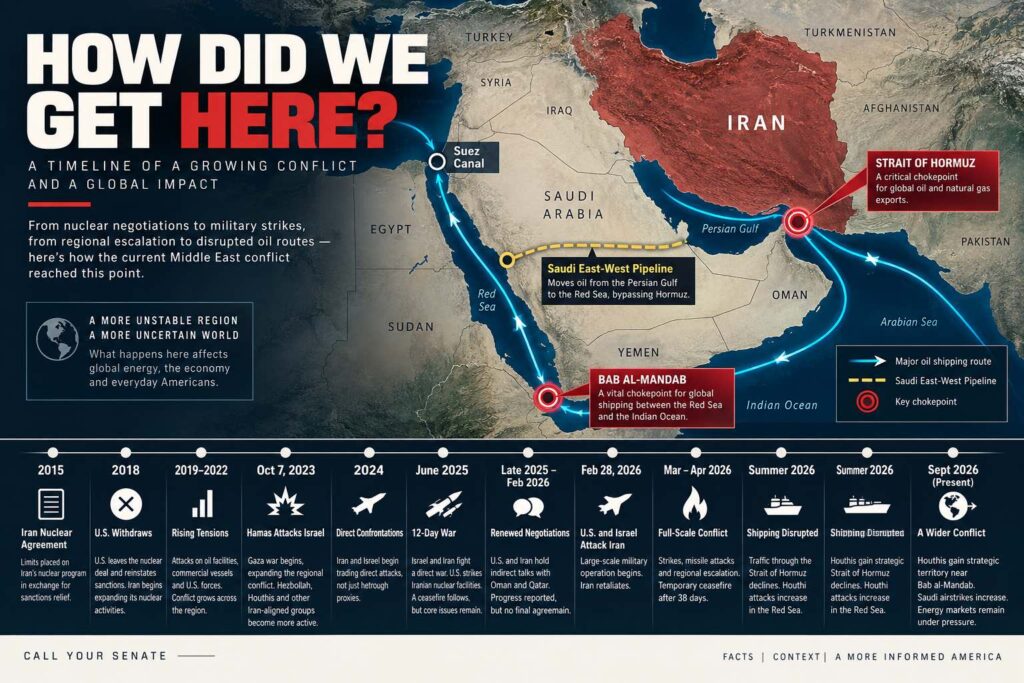
2015 — The Iran Nuclear Agreement
Iran, the United States, Britain, France, Germany, Russia, China and the European Union reached the Joint Comprehensive Plan of Action, commonly called the Iran nuclear deal.
Iran agreed to significant restrictions on its nuclear program and international inspections.
In exchange, nuclear-related economic sanctions were eased.
The agreement was intended to increase the amount of time Iran would need to produce enough highly enriched uranium for a nuclear weapon.
2018 — The United States Leaves the Agreement
President Donald Trump withdrew the United States from the nuclear agreement.
His administration argued that the deal did not sufficiently address Iran’s ballistic missile program, regional armed groups or the long-term future of its nuclear program.
The United States reinstated extensive sanctions on Iran.
Iran initially remained formally within the agreement but eventually began exceeding several of its nuclear restrictions.
That started a cycle in which sanctions increased while Iran’s nuclear program also expanded.
2019–2022 — Escalation Continues
Tensions increased across the Persian Gulf.
Oil facilities and commercial vessels were attacked.
Iran-backed militias attacked U.S. personnel and facilities.
The United States killed Iranian commander Qassem Soleimani in a 2020 drone strike in Baghdad.
Iran retaliated by firing missiles at U.S. bases in Iraq.
Yet even through these confrontations, neither side entered a sustained conventional war.
October 7, 2023 — Hamas Attacks Israel
Hamas attacked Israel, killing civilians and soldiers and taking hostages.
Israel launched the Gaza war in response.
That conflict spread outward.
Hezbollah began fighting Israel from Lebanon.
Iran-backed militias targeted U.S. forces.
The Houthis began attacking commercial vessels in the Red Sea, saying their attacks were connected to the Gaza conflict.
The possibility of a direct Iran-Israel war grew substantially.
2024 — Iran and Israel Exchange Direct Attacks
Iran and Israel increasingly moved away from fighting primarily through proxies.
Iran launched drones and missiles directly toward Israel after an Israeli strike on an Iranian diplomatic compound in Damascus.
Israel later retaliated.
The longstanding shadow conflict was becoming a direct military confrontation.
June 2025 — Israel and Iran Fight a 12-Day War
Israel launched strikes against Iranian nuclear and military targets.
Iran responded with missiles and drones against Israel.
The United States subsequently attacked Iranian nuclear facilities at Fordow, Natanz and Isfahan.
The White House later said those strikes were conducted to defend Israel and protect U.S. security interests.
A ceasefire eventually halted that round of fighting.
But the core disputes remained.
Late 2025–February 2026 — Nuclear Negotiations Resume
Iran and the United States returned to indirect negotiations.
Iran indicated willingness to discuss restrictions on enrichment but rejected demands for eliminating domestic enrichment entirely.
The United States pressed Iran over enrichment, missiles and support for regional armed groups.
Oman and Qatar were attempting to mediate.
Both governments publicly said they wanted to avoid a larger war.
February 2026 — Negotiations Continue
U.S. and Iranian negotiators met again.
The talks ended without a final agreement.
But mediators reported progress, and technical negotiations remained under consideration.
This is one of the most important points in the timeline:
The transition from diplomacy to war did not occur after years in which no diplomatic channel existed. Negotiations were occurring during the same month that the war began.
February 28, 2026 — U.S. and Israel Attack Iran
Israel announced a pre-emptive military operation against Iran.
The United States also began Operation Epic Fury.
The Trump administration said the objectives included eliminating Iran’s nuclear threat, destroying ballistic missile and drone capabilities, weakening its navy and degrading Iran’s ability to project military power throughout the region.
Iran retaliated against Israeli and American targets.
The regional war began.
March–April 2026 — Large-Scale Combat
The United States and Israel struck Iranian military infrastructure.
Iran launched missiles and drones against U.S. and Israeli targets.
The White House later said the initial high-intensity phase lasted roughly 38 days.
Fighting decreased after a ceasefire, but the broader conflict was not resolved.
Summer 2026 — Fighting Resumes
The ceasefire did not produce a permanent political settlement.
Large-scale American strikes resumed.
Pressure around Hormuz intensified.
Iran increasingly used its geographical position around the Persian Gulf as leverage.
Congress also became more involved.
On June 23, the Senate voted 50–48 for a resolution directing the president to remove U.S. forces from hostilities with Iran.
Debate over presidential and congressional war powers has continued since then.
September 2026 — The Conflict Spreads Again
The consequences now extend far beyond Iran.
Iran has continued confronting U.S. forces around Hormuz.
The Houthis have expanded their territorial position around Bab al-Mandab.
Saudi Arabia has launched airstrikes against Houthi positions.
Saudi oil infrastructure has been attacked.
Commercial shipping is being disrupted at both ends of the Arabian Peninsula.
And energy prices remain elevated.
What Was the Original Goal — and Where Are We Now?
The administration presented the February campaign as an operation designed to eliminate major Iranian military threats.
The White House said the initial objectives included destroying Iran’s ballistic missile and drone capabilities, Iran’s navy and portions of its defense-industrial base.
Six months later, however, the United States is still engaged in combat with Iran.
Iran remains capable of threatening shipping.
Negotiations over Iran’s nuclear program have continued even after extensive military action.
And several of the issues eventually being discussed diplomatically resemble the same disputes that existed before February: uranium enrichment, sanctions, regional security and restrictions on Iranian military capabilities.
That does not mean diplomacy was guaranteed to succeed.
Iran and the United States remained far apart on major issues.
Iran’s nuclear activities raised legitimate international concerns, and Iran has supported armed groups that have attacked American forces and U.S. allies.
But the timeline establishes something equally important:
Diplomatic negotiations had not disappeared when military operations began.
The decision was therefore not simply between accepting Iran’s nuclear program and launching military strikes.
There were competing approaches under active consideration.
Congress Never Passed a New Authorization for This War
Another part of the story involves the Constitution.
Article I gives Congress the power to declare war.
Presidents also possess constitutional authority as commander in chief, and administrations of both parties have historically claimed significant authority to conduct limited military operations without a formal declaration of war.
That tension has existed for decades.
The War Powers Resolution of 1973 was intended to limit prolonged presidential military action without congressional authorization.
Congress did not enact a new Authorization for Use of Military Force specifically authorizing the February 2026 war with Iran before major combat operations began.
That has produced a continuing constitutional dispute.
Supporters of the administration argue the president possesses authority to protect U.S. interests, personnel and allies from Iranian threats.
Opponents argue the duration and scale of the conflict exceed the type of short-term defensive military action a president can conduct without congressional authorization.
Congress itself has repeatedly debated resolutions attempting to end or restrict U.S. involvement.
The Senate formally considered such legislation on June 23.
And on September 15, the House again voted on a war-powers measure intended to halt unauthorized military operations against Iran.
That debate is continuing while the war itself continues.
What Has the War Cost Americans?
The effects are no longer abstract.
About $38 billion in direct Pentagon costs
The Congressional Budget Office estimates that military operations against Iran cost the Defense Department approximately $38 billion through August 1.
That includes:
- replacing missiles and other munitions,
- replacing equipment lost in combat,
- additional aircraft operations,
- logistics,
- and higher fuel costs.
CBO estimates continued operations could cost approximately $2 billion to $3 billion every month, with potentially higher costs if fighting intensifies.
The administration has also requested tens of billions of dollars in additional military funding associated with the conflict.
U.S. weapons stockpiles have been affected
CBO identified another consequence that receives less public attention.
Large numbers of missile-defense interceptors have been used.
The agency says replenishing those inventories will take several years and could reduce U.S. flexibility if another major military conflict emerged elsewhere.
The War Is Also Showing Up in Prices
The most visible consequence for many Americans may be energy.
CBO concluded that disruption of:
the Strait of Hormuz
and
Red Sea shipping
has increased global energy prices.
Those increases do not stop at the gas pump.
Diesel affects trucking.
Jet fuel affects airlines.
Petroleum affects manufacturing.
Transportation costs affect food and consumer goods.
CBO therefore concluded that energy disruptions from the Iran conflict are putting broader upward pressure on U.S. inflation.
The agency now estimates that first-quarter 2027 consumer inflation will be about 0.5 percentage point higher than it expected before the conflict.
That is a measurable economic consequence of the war.
The Geography Explains Why the Consequences Became So Large
Look at the map.
There are three critical pieces.
Strait of Hormuz
Iran can threaten one of the world’s most important petroleum-export routes.
↓
Saudi East-West Pipeline
Saudi Arabia can bypass Hormuz by sending oil westward toward the Red Sea.
↓
Bab al-Mandab
Ships leaving the Red Sea must pass through another narrow maritime chokepoint beside Yemen.
The conflict has now placed pressure on all three.
That is how a military confrontation originally centered on Iran’s nuclear and missile programs developed into a problem affecting fuel prices, shipping costs and inflation around the world.
Could This Have Taken a Different Path?
History cannot tell us what would have happened under a different decision.
Diplomatic negotiations might have failed.
Iran might have continued expanding its nuclear capabilities.
Military confrontation might eventually have occurred anyway.
Those possibilities matter.
But so do the facts immediately preceding February 28.
At the moment military operations began:
- Iran’s nuclear program presented genuine unresolved concerns.
- Iran and the United States remained far apart on several issues.
- Iran continued supporting armed organizations opposed to the United States and Israel.
- The United States and Iran were also actively negotiating.
- Oman was mediating.
- Qatar was pushing for de-escalation.
- Negotiators had reported progress.
- Further technical discussions were contemplated.
- Congress had not enacted a new authorization for war with Iran.
Then the military option was chosen.
Six months later, the United States remains engaged in the conflict, Iran’s nuclear question is still unresolved, diplomatic negotiations remain necessary, American taxpayers have absorbed tens of billions of dollars in military costs, and instability has spread into some of the world’s most important energy corridors.
Those facts do not by themselves settle whether the February decision was justified.
They do provide Americans with the information necessary to evaluate that decision for themselves.
What Happens Next?
There are several possible paths.
A diplomatic settlement could reduce attacks and restore normal shipping through Hormuz.
The conflict could remain at its current lower-intensity level.
Or fighting involving Iran, Israel, the United States, Saudi Arabia and the Houthis could deepen.
The most immediate danger is geographic.
The Strait of Hormuz and Bab al-Mandab are not simply regional waterways.
They are pieces of global economic infrastructure.
If both remain substantially disrupted, the consequences can reach American households through fuel, transportation, food prices, airline costs, government spending and inflation.
That is why understanding how this war began matters.
The question is no longer only:
What is happening in Iran?
For Americans, the increasingly relevant questions are:
What decisions brought the United States into this war?
What objectives remain?
What would constitute an end to the conflict?
And what costs are Americans being asked to absorb until that happens?
What This Means
The current Middle East crisis grew out of legitimate security disputes involving Iran’s nuclear program, missile capabilities, support for regional armed groups and decades of hostility toward Israel and the United States.
But the current U.S.-Iran war itself has a specific starting point: February 28, 2026, when the United States and Israel launched major military operations against Iran while diplomatic negotiations over the nuclear dispute were still active.
Iran retaliated.
The war expanded.
Shipping through Hormuz was disrupted.
The Houthis expanded operations around the Red Sea.
Saudi infrastructure came under attack.
And a conflict that began thousands of miles away is now influencing what Americans pay for energy and other goods.
The next question is whether military action produces a durable settlement — or ultimately returns the same unresolved disputes to the negotiating table at a much higher cost.
