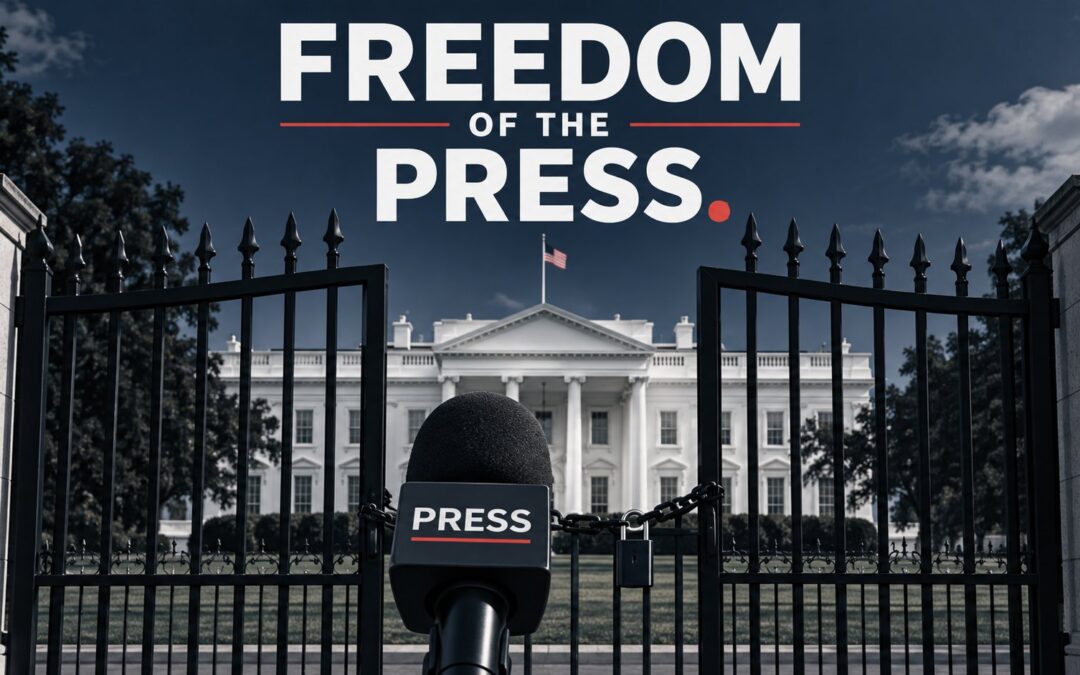
On September 18, Trump announced that the three news organizations would be banned from the White House, accusing them of repeatedly publishing false and misleading coverage of his administration.
By September 19, journalists from all three organizations had been turned away from the White House, with their press credentials deactivated or confiscated, according to reporting by The Associated Press and Reuters.
The restrictions have prompted objections from the affected news organizations and press freedom advocates, who argue that denying journalists access because of their reporting conflicts with the First Amendment.
But does the Constitution require the White House to admit every journalist? And how much authority does a president have to determine which news organizations can cover the administration?
What Happened at the White House?
On Friday, September 18, President Trump announced through Truth Social that CNN, MS NOW and Politico would no longer be permitted at the White House.
The president accused the organizations of reporting what he called “FAKE NEWS” and suggested that additional news outlets could face similar restrictions.
Speaking with reporters in the Oval Office, Trump defended his decision and said the country needs honest reporting.
He also stated that he supports freedom of the press but believes news organizations should provide fair and accurate coverage.
The following morning, the announced restrictions were enforced.
- CNN: White House correspondent Betsy Klein reported that her press credential had been deactivated and confiscated.
- MS NOW: White House correspondent Akayla Gardner reported being turned away after discovering that her credential had been disabled.
- Politico: White House correspondent Cheyenne Haslett was also denied entry and had her credential confiscated.
The three news organizations defended their reporting and indicated that they would take steps to protect their First Amendment rights.
Source: Associated Press, September 19, 2026.
What Does the Constitution Say About Freedom of the Press?
The First Amendment to the United States Constitution protects freedom of speech and freedom of the press.
“Congress shall make no law … abridging the freedom of speech, or of the press.”
United States Constitution, First Amendment
Ratified in 1791 as part of the Bill of Rights, the First Amendment limits the government’s ability to interfere with protected speech and journalism.
Although its language specifically mentions Congress, constitutional protections against federal government interference also apply to executive officials, including the president.
In practical terms, freedom of the press protects the ability of journalists and news organizations to investigate government activities, publish information, ask questions and criticize public officials without improper government retaliation.
The amendment does not require journalists to support the president or provide favorable coverage of government policies.
It also does not prevent a president from criticizing journalists, challenging their reporting or declining individual interviews.
The legal question becomes more complicated when the government uses its authority over access to restrict a news organization because of its protected expression.
Read the constitutional text: U.S. Constitution, First Amendment — Congress.gov.
Can a President Legally Ban Journalists From the White House?
The answer depends on the circumstances.
The First Amendment does not give every journalist an automatic right to enter every government building, attend every presidential event or receive an interview.
Presidents and White House officials may establish reasonable restrictions involving security, available space and the organization of press events.
For example, the White House may limit attendance at a small Oval Office meeting because the room cannot accommodate every credentialed journalist.
However, federal courts have recognized that denying press credentials or restricting access because of protected speech can raise constitutional concerns.
The Important Constitutional Distinction
The government may establish legitimate rules governing press access. But excluding a news organization because officials disagree with its reporting or viewpoint can raise First Amendment concerns.
Courts examining these disputes consider the reasons for the restriction, the type of access involved, how comparable journalists are treated and whether required legal procedures were followed.
Federal Courts Have Addressed Similar White House Press Restrictions
The current dispute is not the first time federal courts have examined a president’s authority over White House press access.
The 1977 White House Press Credentials Case
In Sherrill v. Knight, a journalist challenged the government’s refusal to issue him a White House press pass.
The U.S. Court of Appeals for the District of Columbia Circuit ruled in 1977 that denying press credentials implicates both First Amendment and Fifth Amendment protections.
The court recognized the government’s legitimate interest in protecting the president. However, it also established that journalists denied credentials must receive appropriate procedural protections.
These include notice of the factual reasons for denial, an opportunity to respond and a final written explanation.
The decision established that White House security and constitutional press protections must be considered together.
Read the case: Sherrill v. Knight, 569 F.2d 124 (D.C. Cir. 1977).
The Associated Press Dispute in 2025
Another relevant case involves The Associated Press.
In February 2025, the Trump administration restricted AP journalists from certain presidential events after the organization declined to adopt the administration’s preferred name, “Gulf of America,” as its standard editorial reference for the Gulf of Mexico.
The Associated Press challenged the restrictions in federal court.
In April 2025, a federal district judge granted AP a preliminary injunction, finding that the organization was likely to succeed on its First Amendment claims involving viewpoint discrimination and retaliation.
The government appealed.
In June 2025, a divided federal appeals panel stayed most of the preliminary injunction while allowing the portion concerning the White House East Room to remain in effect.
The appellate ruling did not provide a final resolution of every constitutional issue in the case. It illustrated an important legal distinction between general press credentials and access to smaller, restricted presidential events.
Read the district court ruling: Associated Press v. Budowich, April 8, 2025.
What Is Viewpoint Discrimination?
Viewpoint discrimination occurs when the government treats people or organizations differently because of the opinions or perspectives they express.
Consider two examples:
Example 1: A Space Restriction
The White House limits an event to 12 journalists because the room cannot accommodate everyone. Reporters are selected through reasonable criteria unrelated to their editorial viewpoints.
Such restrictions may be permissible, depending on the circumstances.
Example 2: A Restriction Based on Reporting
The White House allows comparable news organizations to attend but excludes one because its articles criticize the president or because officials disagree with its editorial decisions.
That restriction raises a different constitutional concern because the government may be penalizing protected expression.
This distinction is central to understanding the September 2026 dispute.
Why Does Freedom of the Press Matter to Everyday Americans?
Freedom of the press is not simply a protection for television networks, newspapers or professional journalists.
It also helps Americans receive independent information about the government.
Presidential decisions can affect federal spending, military operations, immigration enforcement, public health, consumer prices and other matters that influence daily life.
Journalists help the public understand those decisions by attending briefings, asking questions, reviewing documents and comparing official statements with independently gathered evidence.
When a news organization loses access to government officials or events, its journalists may have fewer opportunities to ask questions directly or observe government activities.
Other reporters may continue covering those events, and official government communications can still provide information. However, independent reporting serves a different purpose from communications produced by the administration itself.
It allows journalists to pursue questions and information that government officials may not choose to emphasize.
On September 18, the White House Correspondents’ Association issued a statement defending independent press coverage and the public’s ability to receive information about presidential decisions.
The association argued that constitutional press protections do not depend on whether the president approves of a news organization’s coverage.
Read the statement: White House Correspondents’ Association, September 18, 2026.
What Happens Next?
The September 19 enforcement of the restrictions creates several questions that could become central if the affected news organizations pursue legal challenges.
- What specific reasons does the White House provide for revoking the journalists’ credentials?
- Are the restrictions based on security, conduct, administrative concerns or disagreement with the organizations’ reporting?
- Are comparable journalists from other organizations being allowed access?
- Have the affected journalists received the procedural protections required by applicable law?
- How will existing federal court decisions apply to restrictions affecting entire news organizations?
The answers could determine how a court examines the administration’s actions.
As of September 19, CNN, MS NOW and Politico have indicated that they intend to defend their First Amendment rights.
The constitutional questions surrounding the restrictions have not been finally resolved by a court.
The Constitutional Question at the Center of the Dispute
The First Amendment does not grant journalists unlimited access to the president.
It also limits the government’s ability to penalize protected speech and reporting.
Both principles are relevant to the current White House restrictions.
Federal courts have recognized legitimate presidential authority over security and the organization of official events, while also establishing protections against arbitrary press credential decisions and certain forms of viewpoint discrimination.
For the American public, the issue extends beyond the three organizations named in the president’s announcement.
The broader constitutional question is how the government can control access to its operations while preserving the independence of the press that reports on those operations.
Frequently Asked Questions
Can the president stop a news organization from criticizing him?
No. The First Amendment protects news organizations’ ability to publish criticism and other protected expression about government officials. A president may challenge or respond to that reporting, but disagreement does not eliminate constitutional protections.
Can the president refuse to answer questions from a journalist?
Generally, yes. The First Amendment does not require a president to grant every interview or answer every reporter’s question.
Can journalists lose their White House credentials?
Yes, under appropriate circumstances. However, decisions involving press credentials can implicate First Amendment protections and Fifth Amendment due process requirements.
Does freedom of the press apply only to major news organizations?
No. Constitutional protections for speech and press freedom are not limited to large television networks or established newspapers. Independent journalists and smaller publications also receive constitutional protections.
Understand Your Rights. Understand Your Government.
Freedom of the press is one of five protections contained in the First Amendment, alongside freedom of speech, religion, peaceful assembly and the right to petition the government.
Call Your Senate explains how the Constitution, Congress and federal government affect everyday Americans.
Sources and Further Reading
- U.S. Constitution, First Amendment — Congress.gov
- Associated Press: White House Press Restrictions, September 19, 2026
- Reuters: White House Turns Away Journalists, September 19, 2026
- White House Correspondents’ Association Statement
- Sherrill v. Knight, 1977
- Associated Press v. Budowich, April 2025 District Court Decision
