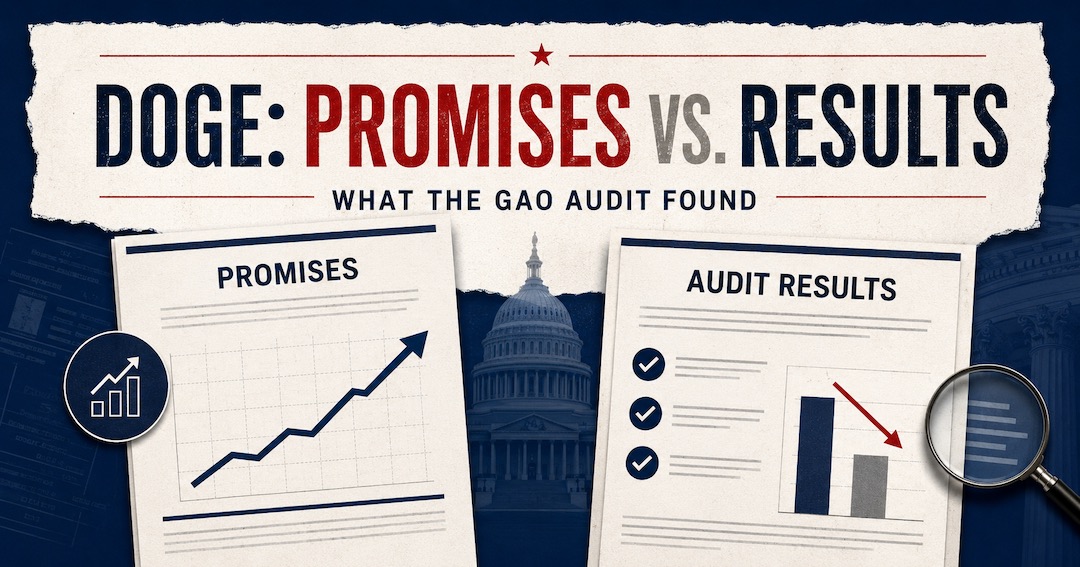
The Department of Government Efficiency, commonly called DOGE, promised to dramatically reduce federal spending, eliminate waste and make government operations more transparent.
Elon Musk initially said the initiative could cut at least $2 trillion from federal spending. That target was later lowered to approximately $1 trillion.
DOGE eventually reported an estimated $215 billion in total savings. But an August 6, 2026, report from the nonpartisan Government Accountability Office found that significant portions of DOGE’s contract, grant and lease savings could not be independently verified.
What This Report Means
The GAO report does not conclude that DOGE produced no savings. Federal auditors found evidence that some contracts, grants and leases were reduced or terminated.
However, GAO also found that DOGE:
- Did not consistently follow its stated savings methodology.
- Reported some contracts as terminated when no termination occurred.
- Provided insufficient information to verify most grant savings.
- Overstated savings from federal leases.
- Did not consistently subtract termination and relocation expenses.
- Sometimes treated possible future cost avoidance as money already saved.
The result is that DOGE’s $215 billion headline remains a reported estimate—not a confirmed amount of net taxpayer savings.
What Did DOGE Originally Promise?
DOGE’s financial target changed several times.
At an October 2024 campaign event, Musk said the federal budget could be reduced by “at least” $2 trillion. He later described $2 trillion as a best-case outcome and said the initiative had a strong chance of saving $1 trillion.
In March 2025, Musk said DOGE could reduce annual federal spending from approximately $7 trillion to $6 trillion. He argued that this could be accomplished by eliminating waste and fraud without reducing essential government services.
President Donald Trump’s original announcement also presented DOGE as a broader government-reform initiative. Its responsibilities included:
- Cutting unnecessary federal spending.
- Reducing regulations.
- Restructuring federal agencies.
- Modernizing government technology.
- Increasing productivity.
- Making spending decisions more transparent.
A January 20, 2025, executive order formally created a temporary DOGE organization within the existing U.S. Digital Service. The temporary organization was scheduled to end on July 4, 2026.
How Much Did DOGE Claim to Save?
As of July 7, 2026, DOGE’s Wall of Receipts claimed approximately $215 billion in total savings.
That figure included contract cancellations, grant terminations, lease reductions, workforce changes, asset sales, regulatory changes, alleged fraud and improper-payment reductions, and other program or operational changes.
The GAO audit did not evaluate every category included in the $215 billion total. It focused specifically on contracts, grants and federal property leases. Those three categories represented approximately $110.34 billion of DOGE’s claimed savings.
- Contracts: $61.02 billion.
- Grants: $49.21 billion.
- Leases: $113 million.
DOGE’s full $215 billion estimate would equal 21.5% of the revised $1 trillion target and approximately 10.8% of the original $2 trillion statement.
Those percentages compare DOGE’s own reported figure with its earlier targets. They do not mean that GAO verified all $215 billion as actual savings.
GAO Found Problems With Contract Savings
DOGE reported approximately $61 billion in savings from 13,476 federal contracts that it identified as terminated.
DOGE said it generally calculated contract savings by subtracting the amount already obligated from the contract’s potential total value, including optional future spending.
GAO attempted to reproduce those calculations using federal procurement records.
Auditors found that DOGE followed its stated methodology for $16.8 billion, or 27.5%, of the reported contract savings. For $37 billion, representing 60.7% of the contract claim, DOGE either used another calculation or GAO could not determine how the amount was calculated. Another $7.2 billion could not be evaluated because identifying information was missing.
Following DOGE’s formula does not necessarily prove that the entire amount became a net taxpayer saving. A contract’s maximum possible value may include optional work the government was never required or expected to purchase.
Some “Terminated” Contracts Were Not Terminated
GAO found that no termination action had been recorded for 2,503 contracts associated with $27.4 billion in DOGE-reported savings.
Other actions may have occurred. For example, an agency could reduce a contract’s maximum value, remove some funding or narrow the work covered by the agreement.
Those actions can reduce future costs, but they are not necessarily the same as terminating a contract.
The Wall of Receipts also lacked identifying information for 3,751 contracts. GAO used additional information to match some of them with federal procurement records, but 1,856 contracts—representing $7.2 billion—could not be linked.
A $1.7 Billion Contract Produced No Identified Savings
One of the clearest examples involved a Defense Health Agency information-technology contract supporting more than 700 military treatment facilities.
DOGE reported $1.7 billion in savings connected to the contract.
According to GAO, the contract was initially considered for termination, but the government ultimately did not terminate it or reduce its scope, value or funding. GAO therefore found that no savings were achieved from that particular action.
What GAO Found in Its Detailed Contract Review
GAO conducted a more detailed examination of 21 contracts at the Department of Defense and Department of Health and Human Services.
DOGE had reported approximately $7.5 billion in savings from those contracts. GAO identified $77.8 million in deobligated funds.
A deobligation removes money previously committed to a contract. It can create savings or allow the money to be used for another government purpose.
GAO also found possible future cost avoidance from reductions in contract scope or maximum value. Those future savings were not guaranteed. In some cases, the government transferred work and related expenses to other contracts.
The 21 contracts were a limited selection, so their results should not be applied automatically to every DOGE contract. The review instead illustrates why contract reductions must be examined individually before being counted as final savings.
Most Grant Savings Could Not Be Verified
DOGE reported $49.21 billion in savings from 15,887 terminated grants.
GAO found insufficient information to verify the calculation used for 13,553 grants. Those grants represented approximately 96% of DOGE’s reported grant savings.
About one in five grants did not contain enough information for GAO to reliably identify them in USASpending.gov. Those unidentified grants accounted for more than half of the reported grant savings.
Grant termination can also generate additional expenses. Recipients may be entitled to reimbursement for eligible costs incurred before termination, along with certain accounting, legal and closeout expenses.
GAO said determining actual grant savings would require reviewing the documentation for each grant.
Lease Savings Were Overstated by More Than $80 Million
DOGE displayed $113 million in savings from 264 federal leases.
However, GAO found that the individual lease entries added up to $53.5 million—not $113 million.
Auditors identified further issues:
- Approximately $15.3 million came from 108 lease terminations already underway before DOGE was established.
- Approximately $5.6 million came from 44 leases that remained active.
- DOGE reported amounts that differed from General Services Administration records.
- Moving, relocation and possible early-termination costs were not deducted.
After adjusting for the problems it identified, GAO calculated $31.8 million in savings associated with the listed leases. That amount still did not account fully for every possible relocation or termination expense.
GAO concluded that the Wall of Receipts overstated lease savings by $81.1 million.
What Is the Difference Between Savings and Cost Avoidance?
The distinction is important when evaluating government spending claims.
Realized Savings
Realized savings occur when the government’s actual net spending decreases. Any termination, replacement or transition costs should be deducted.
Deobligated Funds
A deobligation removes money previously committed to a contract or program. The money may reduce total spending, but it could also be reassigned to another purpose.
Cost Avoidance
Cost avoidance occurs when the government prevents a possible future expense. For example, an agency may decide not to exercise an optional contract extension.
This can be financially beneficial, but it is not the same as recovering money already spent.
Reduced Contract Ceiling
A contract ceiling is the maximum amount the government is allowed to spend under an agreement. Reducing that ceiling does not necessarily save the full difference because the government may never have planned to spend the maximum.
GAO found that DOGE’s reporting did not clearly distinguish among these different types of financial effects.
Did DOGE Save Taxpayers Money?
The available evidence indicates that some DOGE-related actions reduced federal obligations or may prevent future expenses.
The GAO report does not provide enough evidence to calculate one definitive net-savings total. It also does not validate DOGE’s full $215 billion estimate.
Some reported savings may be legitimate. Other amounts involved contracts that remained active, potential rather than realized savings, actions agencies began before DOGE existed, missing or incomplete records, expenses transferred to other contracts, and termination or relocation costs that were not deducted.
Therefore, it would be inaccurate to say either that DOGE definitively saved $215 billion or that it saved nothing.
Did DOGE Meet Its Original Goal?
Based on DOGE’s own $215 billion claim, the initiative did not reach either its $1 trillion revised target or the original $2 trillion statement.
The reported amount was:
- $785 billion below the $1 trillion target.
- $1.785 trillion below the $2 trillion target.
Because the $215 billion figure has not been independently verified as net savings, the actual gap could be larger.
The latest audit also raises questions about whether DOGE fulfilled its transparency promise. DOGE created a public Wall of Receipts, but GAO found that the site omitted important identifiers, calculation methods and data-quality limitations.
What Did GAO Recommend?
GAO recommended that the Executive Office of the President, through the U.S. DOGE Service, prominently disclose known data-quality problems and limitations on the Wall of Receipts.
GAO said this information would help Congress and the public better understand what the reported figures represent.
The U.S. DOGE Service did not provide comments on the report.
What Happens to DOGE Now?
The temporary DOGE organization established by executive order ended on July 4, 2026. An official DOGE social-media post described the formal mission as complete.
However, the broader U.S. DOGE Service was not eliminated by the executive order. Personnel working in federal agencies may continue projects connected to government efficiency, technology modernization and spending oversight.
As of GAO’s July 7 review, the Wall of Receipts remained online, but its last reported update was January 1, 2026.
Frequently Asked Questions
How much did DOGE promise to save?
Elon Musk initially suggested at least $2 trillion in federal spending reductions. He later described that as a best-case result and presented $1 trillion as a more achievable target.
How much did DOGE say it saved?
DOGE reported approximately $215 billion in total estimated savings.
Did GAO verify the $215 billion figure?
No. GAO evaluated approximately $110.34 billion attributed to contracts, grants and leases. It found substantial problems with the calculations and supporting information. The remaining categories behind the $215 billion total were outside this audit’s scope.
Did GAO find any legitimate savings?
Yes. GAO identified deobligated funds and other actions that could reduce costs. It also found that some reported savings were uncertain, unsupported, incorrectly categorized or overstated.
Why can canceling a contract fail to save its full value?
A contract’s total value can include optional future work that the government never committed to purchase. Cancellation can also create settlement costs, or the government may hire another contractor to perform the same work.
Was DOGE an official Cabinet department?
No. Despite its name, DOGE was not a Cabinet-level department created by Congress. President Trump established the U.S. DOGE Service Temporary Organization through an executive order within the Executive Office of the President.
When did DOGE’s temporary organization end?
The temporary organization ended on July 4, 2026. The broader U.S. DOGE Service may continue operating because the executive order did not terminate that permanent entity.
The Bottom Line
DOGE made measurable changes to federal contracts, grants, leases and agency operations. Some of those changes produced financial benefits or could reduce future spending.
But DOGE’s public savings claims went beyond what federal auditors could verify.
The most accurate conclusion is that DOGE reported $215 billion in estimated savings, while GAO found that large portions of the contract, grant and lease figures lacked reliable supporting information. DOGE also fell well short of its original $1 trillion-to-$2 trillion savings ambition based on its own reported total.
For taxpayers and Congress, the unresolved issue is not simply whether DOGE reduced spending. It is whether the government can document the final net savings after replacement costs, settlements, relocation expenses and redirected spending are included.
Last updated: August 14, 2026
Primary Sources: U.S. Government Accountability Office; full GAO report; Executive Order establishing DOGE; DOGE Wall of Receipts.
