
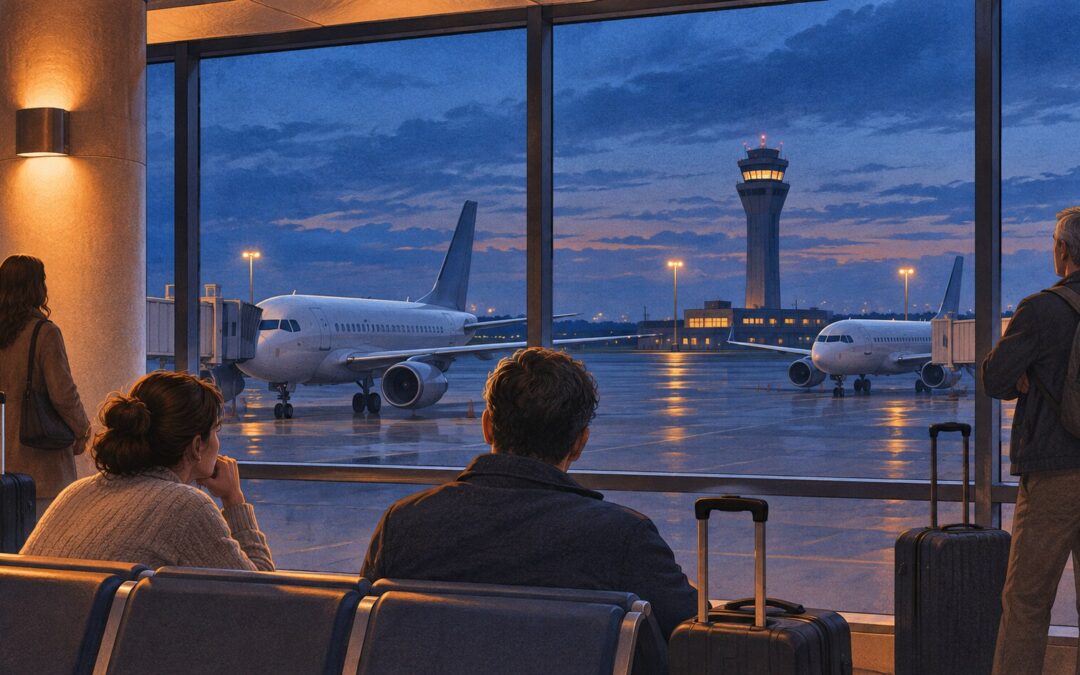
Updated November 13, 2026: The Federal Aviation Administration lifted its nationwide ground stop Friday and said departures could resume, the Associated Press reported. The FAA had paused departures after communications problems affected regional air traffic control centers. The order has ended, but airlines may still need time to reposition planes and crews, so individual flights can remain delayed or canceled.
If you’re traveling: Check each leg of your reservation in your airline’s app or website before leaving for the airport. If you still need to travel, ask for a confirmed seat through to your final destination. If your airline cancels or significantly changes your trip and you decide not to travel, check DOT’s refund rules before accepting a voucher. The FAA’s airspace status page shows system conditions; your airline is the source for your individual flight.
What to Do If You’re Stuck at the Airport
- If you still need to get there, ask for a confirmed rebooking. Start with your reservation in the airline’s app. If it only shows standby or a partial itinerary, ask an agent to confirm a seat through to your final destination. Ask about a different route or partner airline before paying for a separate ticket.
- If you’re stranded overnight, ask what the airline will cover before you book. Ask whether it offers a hotel, meal voucher, ground transportation, or a travel waiver for your itinerary. Check the DOT airline commitments dashboard. The dashboard’s meal and hotel commitments generally apply to disruptions the airline controls. An FAA ground stop does not automatically make the airline responsible for those expenses. Save receipts and ask whether your travel insurance or card benefits apply.
- If you checked a bag, ask where it’s going. Before leaving the airport, ask your airline whether your bag will be held, returned at baggage claim, or sent onward. If it is missing, file a baggage report and keep the reference number.
- If you need disability assistance, ask the airline now. Request help with a gate change, a connection, or an accessible replacement itinerary. If a disability-related problem isn’t resolved, ask for the airline’s Complaint Resolution Official (CRO). DOT’s disability rights guide also lists its hotline: 1-800-778-4838.
When Are You Entitled to a Refund?
Under U.S. Department of Transportation refund rules, airlines generally owe a refund when they cancel or significantly change a flight to, from, or within the United States and you don’t take the changed or replacement flight or accept a voucher or other compensation instead. This can apply even to a nonrefundable ticket and even when the airline did not cause the disruption.
For delays, DOT generally counts arrival at your final destination three hours or more late for a domestic itinerary or six hours or more late for an international itinerary as significant. A change of origin or destination airport or added connections can also qualify. A ground stop by itself does not trigger a refund. If you still plan to travel, check your flight status before canceling the booking yourself.
When a refund is owed, it generally goes back to your original payment method within seven business days for credit-card payments or 20 calendar days for other payment methods. If you booked through a travel agency or third-party site, check your receipt to see who charged you and contact that seller. Keep your booking confirmation, notices, and any written refund response. If you can’t resolve the issue with the airline or seller, file an air travel complaint with DOT.
What the FAA Does and Why It Matters
The FAA is the civil aviation safety agency within the U.S. Department of Transportation. It runs the national air traffic control system, including airport towers and regional centers that guide aircraft between airports. It also sets and enforces safety standards for aircraft operations and maintenance and certifies pilots, aircraft, and airports that serve airlines.
Controllers depend on reliable communications to keep aircraft safely separated and hand them off from one region to the next. A ground stop temporarily holds affected flights before takeoff so controllers can manage aircraft already in the air without adding more traffic to the system. Friday’s outage showed why reliable networks and backup systems matter for passengers, cargo and other flights that share U.S. airspace.
What Congress Can Ask the FAA
Congress sets aviation funding and can examine how the FAA uses it. Lawmakers can ask what failed, which backups worked, how controllers kept aircraft separated, and what fixes could prevent another nationwide disruption. The FAA reported a communications problem; that alone does not establish the underlying cause.
Quick Links for Travelers
- Check your flight or rebook: Use your airline’s app or website. Examples: American Airlines travel alerts and United travel alerts. Check your reservation for route-specific options and deadline details.
- Check the wider airspace situation: FAA National Airspace System Status.
- Check refunds, meals or hotels: DOT refund rules and airline commitments dashboard.
- Get disability assistance or file a complaint: DOT disability rights guide and DOT air travel complaints.
