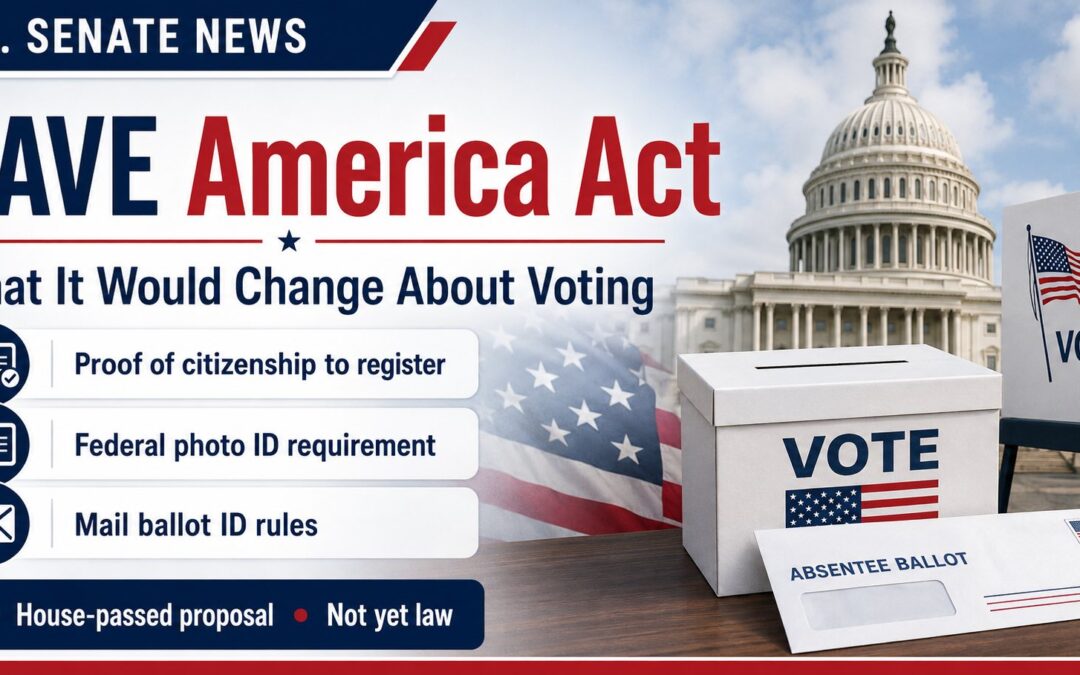
The SAVE America Act would significantly change the rules governing voter registration and voting in federal elections. The legislation would require documentary proof of U.S. citizenship when registering to vote, establish a nationwide photo identification requirement for federal elections and impose new requirements on voters casting ballots by mail or other non-in-person methods.
As of August 10, 2026, however, the SAVE America Act has not passed the Senate and is not law. Senators left Washington for their summer state work period without approving the measure, and Republican leaders have indicated that voting-related legislation could return when the Senate reconvenes.
Here is what the proposal would actually change.
What Is the SAVE America Act?
The Safeguard American Voter Eligibility Act, or SAVE America Act, is federal legislation designed to establish national citizenship-verification and identification requirements for federal elections.
Sen. Mike Lee, R-Utah, and Rep. Chip Roy, R-Texas, introduced the expanded proposal in January 2026. Its two major components are:
- Requiring documentary proof of U.S. citizenship to register for federal elections.
- Requiring qualifying photo identification to cast a ballot in federal elections.
The legislation expands on an earlier SAVE Act proposal by adding the federal photo-ID requirement.
The House approved the legislation on February 11, 2026, by a vote of 218-213. The measure has not received the Senate support necessary for final congressional passage.
What Would the SAVE America Act Change?
The most important distinction is that the bill would affect both registering to vote and casting a ballot in federal elections.
Those are two separate stages of the voting process.
1. Proof of Citizenship Would Be Required to Register to Vote
Under the proposal, a state could not accept and process a voter-registration application for a federal election unless the applicant provides documentary proof of U.S. citizenship.
Qualifying documents could include:
- A valid U.S. passport.
- Certain REAL ID documents that indicate U.S. citizenship.
- Certain military identification combined with a military record showing a U.S. place of birth.
- Certain federal, state or Tribal photo identification showing a U.S. place of birth.
- Government photo identification combined with qualifying citizenship documents such as a certified birth certificate.
- A Consular Report of Birth Abroad.
- A naturalization certificate or certificate of citizenship.
- Certain other federally recognized citizenship records.
The legislation also establishes procedures for applicants whose current name does not match the name appearing on their citizenship documentation, such as someone who changed their last name after marriage.
2. Mail Registration Would Usually Require an Additional In-Person Step
One of the most consequential changes involves people who register using the National Mail Voter Registration Form.
The legislation says an applicant using the mail registration process generally would not be registered for federal elections until documentary proof of citizenship is presented in person to an appropriate election official.
The proof would have to be presented before the state’s registration deadline.
In states that permit registration at a polling place during early voting or on Election Day, an applicant could present the citizenship documentation there by Election Day instead.
States would also be required to provide reasonable accommodations for applicants with disabilities using the mail registration process.
3. A Nationwide Photo-ID Requirement Would Apply to In-Person Federal Voting
The SAVE America Act would establish a federal photo-identification standard for people voting in person.
An election official generally could not provide an in-person voter with a federal-election ballot unless the person presented a qualifying physical photo ID.
The bill identifies several acceptable forms of identification:
- State driver’s license with a photograph and expiration date.
- State-issued motor vehicle identification card with a photograph and expiration date.
- U.S. passport.
- Military identification.
- Qualifying Tribal identification containing a photograph and expiration date.
This would create a nationwide federal requirement even in states whose current election laws use different identification standards.
What Happens If Someone Does Not Have Photo ID at the Polls?
The legislation would not prohibit that voter from casting any ballot at all.
Instead, the voter would be permitted to cast a provisional ballot.
For that ballot to be counted under the bill’s ID provisions, the voter generally would have up to three days after voting to present the required identification to election officials.
The legislation also creates an exception for a voter who signs an affidavit stating that the person does not possess qualifying photo identification because of a religious objection to being photographed.
Plain-English definition: A provisional ballot is a ballot that is set aside until election officials can verify that the voter meets the applicable eligibility requirements.
How Would the SAVE America Act Affect Mail-In Voting?
The legislation would also establish a federal identification requirement for ballots cast other than in person.
Generally, a voter returning such a ballot would have to provide either:
- A copy of qualifying photo identification, or
- The last four digits of the voter’s Social Security number along with an affidavit stating that the voter made reasonable efforts but was unable to obtain a copy of qualifying photo identification.
There are exceptions for certain military voters and some voters covered by federal accessibility protections.
The proposal would therefore change the federal-election mail-ballot process in states that currently do not require voters to submit this type of identification with their ballots.
States would also be directed, where practicable, to make scanners, copiers, printers or similar equipment available free of charge at government facilities such as libraries, courts and police stations so voters could create copies of identification documents.
Would the SAVE America Act Ban Mail Voting?
No.
The legislation does not eliminate mail voting nationwide.
Instead, it would impose new identification requirements on most federal ballots cast outside an in-person polling location.
That distinction is important because debates over the legislation sometimes combine several different proposals involving election administration.
The House-passed SAVE America Act itself establishes requirements for non-in-person ballots rather than eliminating the method entirely.
Would States Have to Review Existing Voter Rolls?
Yes.
The legislation would require states to take ongoing steps to identify noncitizens who may appear on federal voter-registration lists.
Among other provisions, states would periodically submit information from their voter-registration systems to the Department of Homeland Security for comparison with the federal Systematic Alien Verification for Entitlements, or SAVE, system.
If a person were identified as potentially not being a citizen, the legislation requires notice and an opportunity for that person to provide documentary proof of citizenship before removal under the process described in the bill.
States could also use other available data sources to identify potentially ineligible registrations.
Isn’t Noncitizen Voting Already Illegal?
Yes. Noncitizens are already prohibited under federal law from voting in elections for federal offices, subject to narrow statutory exceptions.
Federal law, 18 U.S.C. § 611, makes it unlawful for a noncitizen to vote in an election involving candidates for president, vice president, U.S. Senate, U.S. House and certain other federal offices. Violations can result in fines, imprisonment or both.
The policy debate surrounding the SAVE America Act is therefore not primarily about whether noncitizen voting should be legal.
It is about what documentation and verification procedures the federal government should require to enforce the citizenship requirement.
How Does Voter Registration Work Now?
Under current federal voter-registration procedures, the National Mail Voter Registration Form is intended for U.S. citizens and requires applicants to provide information specified under federal and state law.
The Election Assistance Commission notes that the federal form can be used by U.S. citizens to register, change an address, update registration information or select a political party where applicable. Applicants must also follow additional state-specific rules.
The SAVE America Act would move federal law toward a documentary verification system, rather than relying on the existing combination of applicant certification, identifying information and state election procedures.
Who Would Be Most Affected by the Changes?
If enacted as currently written, the practical effects would vary depending on an individual’s circumstances and existing state law.
People living in states that already require qualifying photo identification might notice fewer changes when voting in person.
Other voters could face additional steps.
Examples could include:
- First-time voters registering for federal elections.
- People registering by mail.
- Voters who do not possess one of the specified forms of photo ID.
- Citizens who need to obtain a birth certificate or other citizenship document.
- Naturalized citizens using citizenship documentation.
- People whose current legal name differs from the name appearing on older citizenship documents.
- Voters casting ballots by mail who would need to satisfy the new identification requirement.
The bill contains procedures addressing several of these circumstances, including name discrepancies, disability accommodations, provisional ballots and alternative documentation.
What Do Supporters of the SAVE America Act Say?
Supporters argue that documentary citizenship verification and uniform photo-ID requirements would strengthen election safeguards and increase public confidence that only eligible U.S. citizens participate in federal elections.
Lee and Roy have described the legislation as a way to create consistent national standards for verifying citizenship and voter identity.
Supporters also point out that driver’s licenses or other state identification documents may be available to some noncitizens and argue that a separate citizenship-verification requirement is therefore necessary.
What Do Opponents Say?
Opponents agree that only eligible citizens should vote in federal elections but argue that the additional documentation requirements could create unnecessary obstacles for eligible citizens who do not readily possess the required records.
Democratic senators have also objected to creating a new nationwide election requirement when states traditionally administer many aspects of voter registration and voting.
Opponents have specifically raised concerns about older voters, lower-income citizens, people who have changed their names and voters who may need time or money to obtain replacement citizenship documents.
Those are arguments about the potential effects of the legislation, rather than evidence that the provisions are currently in force.
Has the SAVE America Act Passed the Senate?
No.
The House approved the legislation on February 11, 2026, but efforts to move it through the Senate have repeatedly failed to secure sufficient support.
For example, the Senate failed to advance a SAVE America Act-related measure in March, and other attempts to attach provisions of the legislation to larger bills have also fallen short.
Republicans currently hold a Senate majority, but most legislation requires 60 votes to overcome a filibuster and advance to a final vote unless a special procedure applies.
President Donald Trump has urged Senate Republicans to pass the measure and has called for changes to Senate rules if necessary. Senate Majority Leader John Thune has maintained that the votes have not been available to do so.
The Senate left Washington for its August state work period without passing the bill.
Could Parts of the Bill Still Pass?
Yes.
Failure to pass the full SAVE America Act does not necessarily end the debate.
Republican senators have discussed attaching portions of the proposal to other legislation or pursuing narrower election measures.
Previous Senate votes in 2026 have already involved amendments containing some SAVE America Act concepts, including voter ID and citizenship-verification requirements.
Any modified proposal would have to be evaluated based on its own legislative text because it may differ significantly from the House-passed legislation.
SAVE America Act: Current Law vs. Proposed Changes
Citizenship eligibility
Current law: Only eligible U.S. citizens may vote in federal elections; noncitizen voting in federal elections is already prohibited.
SAVE America Act: Would add a federal documentary proof-of-citizenship requirement when registering for federal elections.
In-person voting
Current law: Identification requirements differ significantly by state.
SAVE America Act: Would establish a nationwide qualifying photo-ID requirement for federal elections.
Registering by mail
Current law: Eligible citizens can use the National Mail Voter Registration Form subject to federal and state requirements.
SAVE America Act: Mail applicants generally would also have to present documentary citizenship evidence in person before being registered for federal elections.
Voting by mail
Current law: Requirements depend largely on state law.
SAVE America Act: Most voters casting federal ballots outside an in-person polling location would need to provide a copy of photo ID or satisfy the bill’s alternative Social Security number and affidavit procedure.
Voter rolls
Current law: States maintain voter-registration databases under existing state and federal requirements.
SAVE America Act: Would establish additional citizenship-verification and voter-list review requirements, including use of federal immigration-status databases.
Frequently Asked Questions
What does the SAVE America Act do?
The SAVE America Act would require documentary proof of U.S. citizenship to register for federal elections and qualifying photo identification to cast a federal-election ballot. It also creates new requirements for mail ballots and voter-roll citizenship verification.
Is the SAVE America Act currently law?
No. As of August 10, 2026, it has not passed the Senate and is not federal law.
Would I need a birth certificate to register?
Not necessarily. A certified birth certificate is one of several documents or combinations of documents the legislation allows. A valid U.S. passport and certain other government citizenship documents could also qualify.
Would everyone need photo ID to vote?
For federal elections, the bill generally requires qualifying photo identification. Voters without it could use a provisional ballot process, and the legislation provides certain exceptions.
Would the SAVE America Act eliminate mail-in voting?
No. It would add identification requirements for most federal ballots cast outside an in-person voting location, but the legislation does not create a nationwide ban on mail voting.
Is it already illegal for noncitizens to vote for president or Congress?
Yes. Federal law already prohibits noncitizen voting in federal elections, subject to narrow statutory exceptions.
What happens to the SAVE America Act next?
The legislation could return when senators reconvene, or lawmakers could attempt to advance individual provisions through other bills or amendments. No future Senate vote guarantees passage.
The Bottom Line
The SAVE America Act would make some of the most significant nationwide changes to federal voter identification and registration procedures in years.
Its central changes are straightforward: documentary proof of citizenship to register, qualifying photo identification to vote in person, additional identification requirements for mail ballots and expanded citizenship checks of voter-registration lists.
Supporters argue those requirements would strengthen election integrity and public confidence. Opponents argue they would create additional barriers for some eligible citizens.
For now, neither argument changes the legislation’s legal status.
The SAVE America Act has passed the House but has not passed the Senate. Its proposed requirements are therefore not currently federal law.
Last updated: August 10, 2026
Primary Sources: U.S. Government Publishing Office; U.S. Senate; U.S. House Clerk; U.S. Election Assistance Commission; United States Code.
Additional Reporting: Associated Press.
