
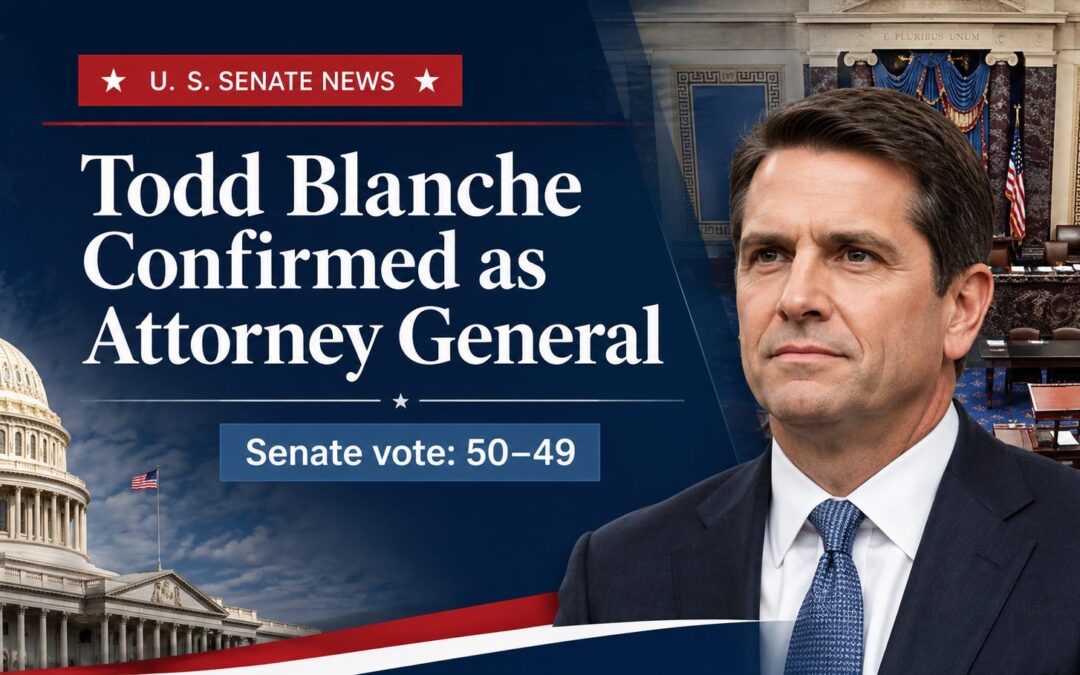
The U.S. Senate confirmed Todd Blanche as attorney general on August 8, 2026, in a narrowly divided 50-49 vote. Two Republican senators joined Democrats and independents in opposing the nomination, concluding a contentious confirmation process over Blanche’s previous representation of President Donald Trump and questions about Justice Department independence.
What Happened?
The Senate voted at 4:17 a.m. on Saturday, August 8, to confirm Todd Blanche as attorney general of the United States.
The official Senate roll call recorded 50 senators in favor, 49 opposed and one not voting. Republican Sens. Susan Collins of Maine and Lisa Murkowski of Alaska joined Democrats and independents in voting against the nomination. Republican Sen. Mitch McConnell of Kentucky did not vote.
Blanche needed only a simple majority to be confirmed.
His confirmation means he can now serve as attorney general without the temporary limitations associated with serving in an acting capacity.
Key Facts About the Todd Blanche Confirmation
- Nominee: Todd Blanche
- Position: Attorney General of the United States
- Confirmation date: August 8, 2026
- Senate vote: 50-49
- Republicans voting against: Susan Collins of Maine and Lisa Murkowski of Alaska
- Not voting: Mitch McConnell of Kentucky
- Result: Confirmed
The vote was Senate Roll Call Vote No. 230 of the 119th Congress.
Who Is Todd Blanche?
Blanche is a former federal prosecutor who became nationally known as a defense attorney for Donald Trump before joining the Justice Department.
He represented Trump in criminal proceedings, including his New York criminal case, and also represented him in federal criminal cases. Blanche later entered the Justice Department as deputy attorney general, the department’s second-ranking position.
He became acting attorney general in April 2026 and had already been overseeing the department before receiving permanent Senate confirmation.
As attorney general, Blanche now leads the Department of Justice.
The attorney general supervises a department that includes the FBI, Drug Enforcement Administration, Bureau of Alcohol, Tobacco, Firearms and Explosives, Bureau of Prisons, U.S. Attorneys and U.S. Marshals Service, among other components.
Why Was Blanche’s Confirmation Contested?
Much of the debate surrounding Blanche’s nomination centered on whether he would maintain sufficient independence between the Justice Department and the White House.
Democratic senators raised concerns about Blanche’s previous role as Trump’s personal attorney and decisions made during his time leading the Justice Department.
Some Republican senators also raised concerns.
One major issue involved a proposed $1.8 billion compensation fund connected to a settlement of Trump’s lawsuit against the Internal Revenue Service. Questions were also raised about provisions restricting certain IRS audits involving Trump, members of his family and their businesses.
During negotiations with senators, Blanche agreed in writing to abandon the proposed compensation fund and narrow the tax-related protections. Those commitments helped move his nomination forward.
Republican senators also questioned the department’s handling of records connected to Jeffrey Epstein.
What Did Supporters Say?
Supporters focused on Blanche’s experience as a federal prosecutor and his previous leadership experience inside the Justice Department.
Senate Judiciary Committee Chairman Chuck Grassley, R-Iowa, supported Blanche and argued that his record at the department demonstrated that he was qualified to lead it. The Judiciary Committee advanced the nomination 12-10 before the full Senate vote.
Sen. Bill Cassidy, R-La., emerged as an important vote late in the confirmation process.
Cassidy ultimately supported Blanche after meeting with him and reviewing the commitments he made regarding the disputed settlement provisions. Cassidy argued that Blanche’s existing relationship with Trump could potentially allow him to communicate legal limits to the president more effectively.
What Did Opponents Say?
Opponents focused primarily on Justice Department independence and Blanche’s previous relationship with Trump.
Murkowski cited several concerns in explaining her opposition, including the handling of Epstein-related records, the tax protections included in the disputed settlement and other Justice Department actions.
Collins also voted against the nomination.
Democratic senators broadly opposed Blanche, arguing that his record raised concerns about whether the Justice Department would operate independently from the White House.
The final vote, however, largely followed party lines. All 50 votes confirming Blanche came from Republican senators.
Why Does the Attorney General Matter?
The attorney general is the nation’s chief federal law enforcement official and oversees the Department of Justice.
That gives the attorney general significant influence over federal law-enforcement priorities, criminal prosecutions, civil-rights enforcement, antitrust enforcement, immigration litigation, national-security cases and other federal legal matters.
The office also supervises agencies including the FBI, DEA, ATF, Bureau of Prisons, U.S. Marshals Service and the country’s U.S. Attorneys.
Because of that authority, attorney general nominations can generate significant Senate scrutiny regardless of which political party controls the White House.
Why Did the Senate Have to Confirm Blanche?
The Constitution gives the president the authority to nominate certain senior federal officials while giving the Senate the responsibility to provide “advice and consent.”
That means a president can select an attorney general nominee, but the Senate must confirm that person before the nominee can permanently occupy the position.
The Senate exercises this constitutional authority over Cabinet officials, federal judges and numerous other senior government positions.
Unlike legislation, confirmation of an attorney general does not require a vote in the House of Representatives.
What Does Blanche’s Confirmation Mean?
The immediate result is straightforward: Todd Blanche has been confirmed by the Senate to lead the Department of Justice.
The larger questions concern how he will use that authority.
Supporters expect Blanche to continue the administration’s law-enforcement priorities and point to his prosecutorial and Justice Department experience.
Critics will be watching whether the Justice Department maintains independence in investigations and prosecutions involving the president’s political interests, associates or opponents.
Those questions cannot be answered by the confirmation vote itself. They will depend on decisions Blanche and the Justice Department make while he is in office.
Frequently Asked Questions
Was Todd Blanche confirmed as attorney general?
Yes. The Senate confirmed Todd Blanche as U.S. attorney general on August 8, 2026, by a vote of 50-49.
Which Republicans voted against Todd Blanche?
Republican Sens. Susan Collins of Maine and Lisa Murkowski of Alaska voted against Blanche’s confirmation.
Which senator did not vote?
Republican Sen. Mitch McConnell of Kentucky was recorded as not voting.
Did Democrats vote for Todd Blanche?
No. The official Senate roll call shows that no Democratic senator voted to confirm Blanche. The Senate’s two independents, Angus King of Maine and Bernie Sanders of Vermont, also voted against confirmation.
Does the House have to confirm the attorney general?
No. Presidential nominations such as attorney general are considered by the Senate. The House of Representatives does not vote on the nomination.
What happens next?
Following Senate confirmation, Blanche can serve as the permanent attorney general and continue leading the Department of Justice. Unlike a bill passed by Congress, there is no additional House vote required.
The Bottom Line
Todd Blanche’s confirmation gives President Trump a Senate-confirmed attorney general after a closely divided confirmation fight.
The 50-49 vote reflected concerns among Democrats and two Republican senators about Blanche’s independence and previous decisions at the Justice Department. Supporters emphasized his experience as a prosecutor, his leadership of the department and commitments he made during the confirmation process.
With the confirmation completed, attention now shifts from what senators said about Blanche to how he leads the Justice Department and exercises the authority of the attorney general.
Last updated: August 8, 2026
Sources: Official U.S. Senate Roll Call Vote No. 230; U.S. Department of Justice; U.S. Senate historical materials on presidential nominations; Associated Press; Reuters.
