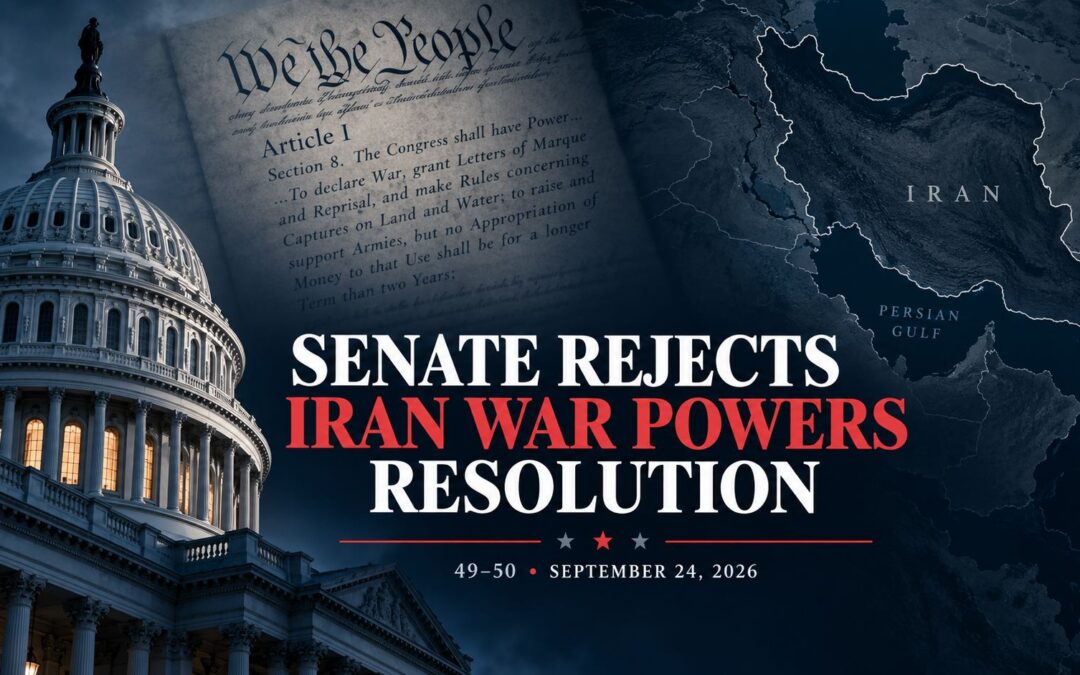
Quick answer: The U.S. Senate rejected H. Con. Res. 89 on September 24, 2026, by a 49–50 vote. The resolution would have directed the president to remove U.S. forces from hostilities with Iran under the War Powers Resolution. Because it failed, U.S. military policy did not change. The vote also did not authorize a war with Iran.
Key facts
- Measure: H. Con. Res. 89
- Vote: 49–50; one senator did not vote
- Date: September 24, 2026
- Result: Rejected
- Immediate effect: Existing U.S. military operations and presidential policy remained unchanged
- What it did not do: The vote did not create a congressional authorization for war
The Senate has rejected a resolution that would have required the president to remove U.S. forces from hostilities with Iran unless Congress separately authorized the operation.
The chamber voted 49–50 against H. Con. Res. 89. Four Republican senators—Susan Collins of Maine, Lisa Murkowski of Alaska, Rand Paul of Kentucky and Thom Tillis of North Carolina—voted for the resolution. Democratic Sen. John Fetterman of Pennsylvania voted against it. Democratic Sen. Angela Alsobrooks of Maryland did not vote.
The official roll call is available from the U.S. Senate.
What was H. Con. Res. 89?
H. Con. Res. 89 was a concurrent resolution brought under the War Powers Resolution. Its central purpose was to direct the president to remove U.S. Armed Forces from hostilities with Iran unless Congress had declared war or enacted a specific authorization for the operation.
A concurrent resolution can express the position of both chambers and, in the war-powers process, can force congressional consideration of a withdrawal question. It does not become law through the ordinary process of presidential signature. In this case, the Senate’s rejection ended the measure’s immediate path through Congress.
What did the Senate vote change?
Nothing changed immediately in U.S. military policy. Because the withdrawal resolution failed, it did not direct the president to end the operation or remove U.S. forces from the hostilities covered by the measure.
The result leaves the executive branch’s existing policy in place while Congress remains divided over whether, when and how it should authorize or limit military action involving Iran.
The narrow vote is politically significant, but it should not be described as Congress authorizing war. Rejecting a withdrawal resolution is not the same legislative act as passing a declaration of war or a specific authorization for the use of military force.
How did senators vote?
The resolution received 49 votes in favor and 50 votes against, with one senator not voting. The cross-party votes were:
- Republicans voting yes: Susan Collins, Lisa Murkowski, Rand Paul and Thom Tillis
- Democrat voting no: John Fetterman
- Not voting: Angela Alsobrooks
Readers can review every senator’s position on the official Senate roll-call page.
Why does a 49–50 vote matter?
The one-vote margin shows that the Senate was closely divided over whether to use the War Powers Resolution to require a change in military policy. It also gives constituents a clear, recorded answer about where each participating senator stood on this particular withdrawal measure.
But the vote answers only one legislative question: whether the Senate would approve H. Con. Res. 89. It does not resolve the broader constitutional dispute over the scope of presidential power, Congress’s authority to declare war, or whether lawmakers should pass a tailored authorization for continuing hostilities.
What does the War Powers Resolution require?
The War Powers Resolution was enacted to promote the “collective judgment” of Congress and the president when U.S. forces are introduced into hostilities. It states that presidential authority to introduce forces into hostilities is exercised pursuant to a declaration of war, specific statutory authorization, or a national emergency created by an attack on the United States, its territories or possessions, or its armed forces.
The law also establishes reporting and congressional procedures. Presidents of both parties have disputed aspects of the law’s constitutionality or application, while members of Congress have repeatedly used war-powers resolutions to force votes on overseas military operations.
Read the current statutory text in the U.S. Code, Title 50, Chapter 33.
Who is affected?
The most direct consequences fall on U.S. service members participating in or supporting military operations and on their families. The continuing policy debate also matters to taxpayers responsible for military costs.
Broader effects can reach households and businesses through energy prices, shipping risks, insurance costs and supply-chain disruptions. Those economic outcomes depend on events in the region and global markets; the Senate vote alone does not determine gasoline prices or other consumer costs.
For a broader chronology and economic context, see CYS’s Iran conflict timeline and economic-cost explainer.
What happens next?
Congress still has several tools available. Senators and representatives may introduce another war-powers resolution, propose a specific authorization for the use of military force, attach limits or reporting requirements to defense legislation, or restrict funding for particular operations.
Committees may also hold oversight hearings and request legal, operational and cost information from the administration. Whether any of those actions advances will depend on the exact proposal and the votes available in both chambers.
The executive branch may continue to rely on its stated constitutional and statutory authorities unless Congress changes the law, restricts funding, or a court issues a controlling ruling. CYS will distinguish any future proposal from an enacted restriction or authorization.
Ask your senators a specific question
Do they support a defined authorization for military action involving Iran, enforceable funding limits, a withdrawal deadline, or continuation of the current policy? Ask what geographic scope, objectives, reporting requirements and expiration date they would support.
Frequently asked questions
Did the Senate authorize war with Iran?
No. The Senate rejected a resolution directing the removal of U.S. forces. That rejection did not enact a declaration of war or a specific authorization for the use of military force.
Did the vote end U.S. military operations involving Iran?
No. H. Con. Res. 89 failed, so it did not require the president to remove U.S. forces from the hostilities addressed by the resolution.
What was the final vote?
The Senate rejected the resolution 49–50 on September 24, 2026. One senator did not vote.
Which Republicans supported the resolution?
Sens. Susan Collins, Lisa Murkowski, Rand Paul and Thom Tillis voted for it.
Which Democrat opposed the resolution?
Sen. John Fetterman voted against it.
Can Congress vote on Iran policy again?
Yes. Lawmakers can introduce new war-powers measures, debate a specific military authorization, impose funding conditions, or pursue oversight and reporting requirements.
Sources and methodology
This article relies on the official Senate roll call for vote totals and individual senators’ positions, and on the official U.S. Code for the statutory framework. Statements about future legislation are possibilities, not confirmed scheduled action.
Last updated September 28, 2026. CYS separates confirmed votes and enacted policy from proposals, political claims and unresolved legal questions.
