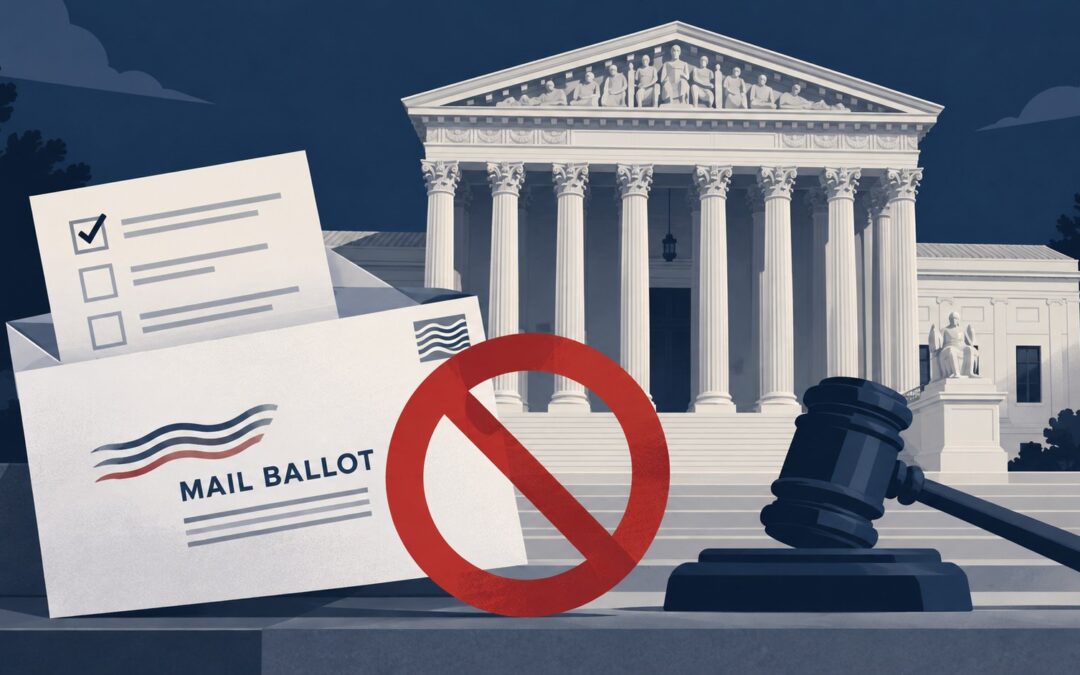
The Supreme Court has rejected an emergency request from the Trump administration to allow new U.S. Postal Service requirements for mail-in ballots to take effect before the November 3, 2026 midterm elections.
The September 14 decision means states can continue administering mail voting under their existing procedures while the legal challenge continues.
The ruling does not permanently invalidate the Postal Service’s new ballot rules, and it does not decide every constitutional question surrounding them. But for the 2026 election, the new federal requirements remain blocked.
What This Decision Means
The immediate result is straightforward:
The Postal Service cannot require states to adopt the new federal ballot-envelope, barcode and voter-data system for the November 2026 election.
A federal district court had already issued a preliminary injunction stopping mandatory portions of the rule. The Trump administration asked the Supreme Court to suspend that injunction while the government appealed.
The Supreme Court declined.
In its September 14 order, the Court said the government was “unlikely to succeed on the merits” of its challenge to the injunction and that the other factors required for emergency relief did not favor allowing the rule to take effect.
That keeps the lower court’s injunction in place for elections occurring through November 3, 2026.
What Were the New Mail-Ballot Rules?
The controversy began with an executive order President Donald Trump signed on March 31, 2026.
Among other election-related provisions, the order directed the Postal Service to develop uniform standards for mail-in and absentee ballots used in federal elections. The administration said the changes were intended to strengthen election security, improve ballot tracking and prevent improper use of the mail.
The Postal Service later issued a final rule titled “Ballot Mail for Federal Elections.”
The rule required new procedures for ballot mail, including:
- Specialized markings identifying envelopes as official election mail.
- Envelopes capable of being processed using USPS automated equipment.
- Unique Intelligent Mail barcodes tied to individual ballot mail pieces.
- USPS review of certain ballot-envelope designs.
- State and local election officials using a federal ballot-mail portal.
- Election officials submitting specified voter and ballot-mail information through that system.
Under the rule, certain outgoing federal ballot mail that did not meet the requirements could be rejected and returned to election officials for correction.
The Postal Service argued that these requirements regulated the mail system, not voter eligibility. USPS said states would continue determining who could vote, who qualified for mail voting and whether returned ballots could be counted.
Why Did States Challenge the Rule?
States, election officials and voting-rights organizations argued that implementing an entirely new ballot-mail system shortly before the election could disrupt election administration.
One major concern was timing.
By September, some jurisdictions had already designed or printed ballot envelopes, while federal law requires ballots for many military and overseas voters to be sent at least 45 days before a federal election. Election officials told the courts that redesigning envelopes, implementing new barcode systems and adopting a federal data portal so close to the election could create delays and increase costs.
The challengers also questioned whether the Postal Service possessed the statutory authority to make compliance with those requirements mandatory.
On September 4, U.S. District Judge Indira Talwani issued a preliminary injunction preventing USPS from enforcing the mandatory portions of the rule for the November 3 election.
The administration then sought emergency relief from the Supreme Court.
What Did the Supreme Court Actually Decide?
The Supreme Court’s order was brief.
The Court denied the administration’s request to temporarily lift the injunction, concluding that:
“The Government is unlikely to succeed on the merits of its challenge to the District Court’s preliminary injunction.”
The Court also said the traditional equitable factors used to decide whether emergency relief should be granted did not support the administration’s request.
That language is significant, but it is important not to overstate what happened.
This was an emergency stay decision, not a final Supreme Court judgment after full briefing and oral argument over the ultimate legality of the Postal Service rule.
The underlying litigation can continue.
Kavanaugh: USPS May Have Authority, But Not This Late
Justice Brett Kavanaugh wrote separately.
Kavanaugh said there was at least a reasonable possibility that the Postal Service has statutory authority to establish some of the requirements.
His concern was timing.
He concluded that applying the rule to the 2026 election would likely be “arbitrary and capricious” under the federal Administrative Procedure Act because state and local election officials did not have enough time to reasonably implement the new system before voting began.
That distinction could matter later.
Kavanaugh’s opinion suggests that a similar rule adopted with significantly more preparation time could present a different legal question.
Alito and Thomas Dissented
Justice Samuel Alito dissented, joined by Justice Clarence Thomas.
Alito argued that the government had met the legal requirements necessary for the Court to suspend the nationwide injunction.
He also questioned whether some of the parties challenging the rule had standing to sue and disagreed with the legal theory supporting the injunction.
The other justices did not issue separate explanations.
Why This Matters to Voters
Mail voting remains a significant part of American elections.
According to the U.S. Election Assistance Commission, approximately 30.3% of ballots cast in the 2024 presidential election were cast by mail. Nearly 48 million mail ballots were returned by voters that year.
That makes even administrative changes to ballot-mail systems potentially consequential.
For voters, however, the Supreme Court ruling means there is no new nationwide USPS process that voters must learn for the November 2026 election.
Voters should continue following the absentee and mail-ballot instructions provided by their state and local election officials.
Deadlines, eligibility requirements, identification rules and rules governing when a mail ballot must be received can still differ significantly from state to state.
Is This a Ruling About States’ Rights?
The dispute raises broader questions about who controls federal election administration, but the September 14 Supreme Court order did not definitively resolve those constitutional questions.
The Constitution gives states the initial authority to determine the “Times, Places and Manner” of congressional elections, while also giving Congress authority to alter those rules.
That structure is one reason challenges have questioned whether an executive-branch agency such as USPS can impose election-related requirements without legislation from Congress.
The administration argues that USPS is regulating use of the federal postal system under authority Congress has already given the agency—not deciding who may vote or how ballots are counted.
The challengers argue that the new requirements go beyond normal postal regulation and effectively interfere with state election administration.
Those arguments remain part of the broader litigation.
What Happens Next?
The injunction remains in place for the November 3, 2026 midterm election.
The government may continue its appeals challenging the legality of the injunction and the underlying conclusions about USPS authority.
A future Supreme Court case could therefore address whether the Postal Service can legally impose similar ballot-mail standards when an election is not imminent.
For now, though, the practical question for 2026 has largely been answered:
States will conduct mail voting without being required to adopt the Postal Service’s new mandatory ballot-mail system for this year’s midterms.
CYS Bottom Line
What happened: The Supreme Court rejected the Trump administration’s emergency attempt to enforce new USPS mail-ballot requirements.
Date: September 14, 2026.
Vote: The Court did not publish a conventional signed majority opinion. Justices Samuel Alito and Clarence Thomas publicly dissented, while Justice Brett Kavanaugh wrote separately agreeing that the rule should remain blocked for the 2026 election.
What changes for voters: Nothing immediately. Continue using your state’s existing mail- or absentee-ballot process.
Is the USPS rule permanently dead? No. The litigation can continue, and future ballot-mail rules adopted with more lead time could raise different legal questions.
2026 impact: The mandatory portions of the new USPS system cannot take effect for the November 3 midterm election.
