
Published: August 19, 2026
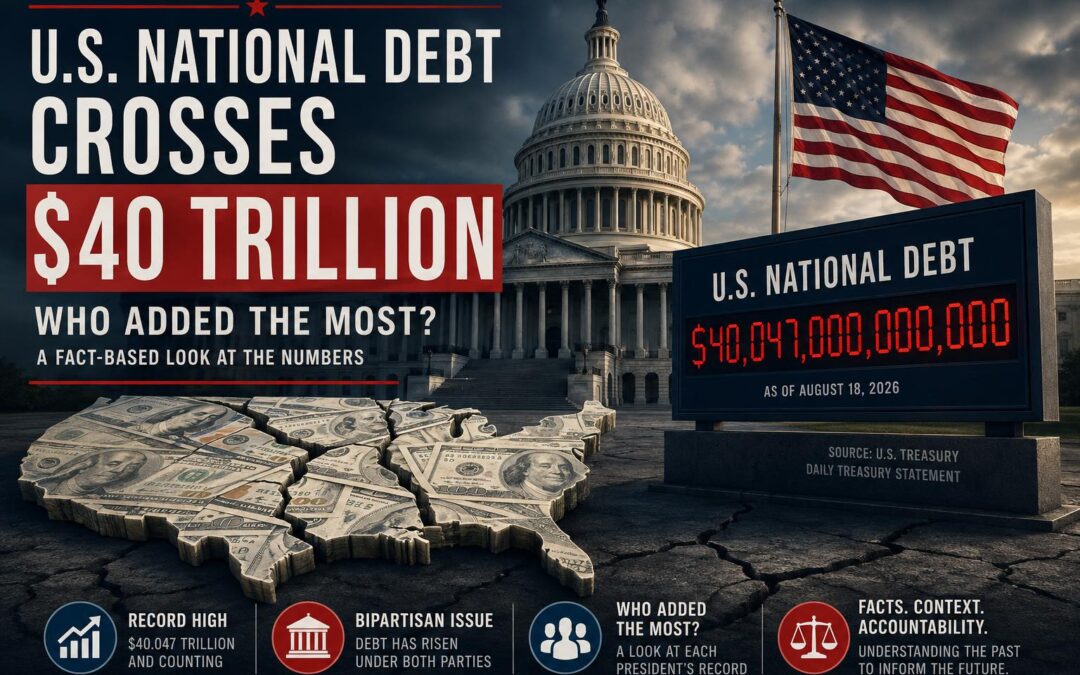
The U.S. national debt crossed $40 trillion for the first time on August 18, 2026. Treasury data show gross federal debt reached approximately $40.047 trillion. Among recent completed presidencies, Barack Obama oversaw the largest nominal increase, followed by Joe Biden and Donald Trump’s first term. However, presidents do not control federal debt alone: Congress controls spending and taxation, and economic conditions, wars, emergencies and previously enacted programs also affect borrowing.
What This Means
The national debt is the accumulated amount the federal government has borrowed over time because spending has exceeded revenue. A budget deficit is the shortfall in a single year. The national debt is the accumulation of past borrowing.
It is also inaccurate to assign the national debt entirely to presidents.
The Constitution gives Congress the power of the purse. Congress passes spending and tax legislation, while presidents propose budgets and sign or veto legislation. Economic recessions, wars, emergency spending, interest costs and programs enacted years earlier can also substantially change the debt during a president’s term.
For that reason, the numbers below show how much gross federal debt changed while each president was in office, not how much debt that president personally created.
Take the Next Step
Federal Debt Is a Congressional Issue
Congress controls federal spending and taxation. See who represents you and contact your senators about budget priorities, federal spending and the national debt.
Which Modern Presidents Saw the Largest Debt Increases?
Using Treasury debt figures around presidential inauguration dates provides a relatively consistent comparison.
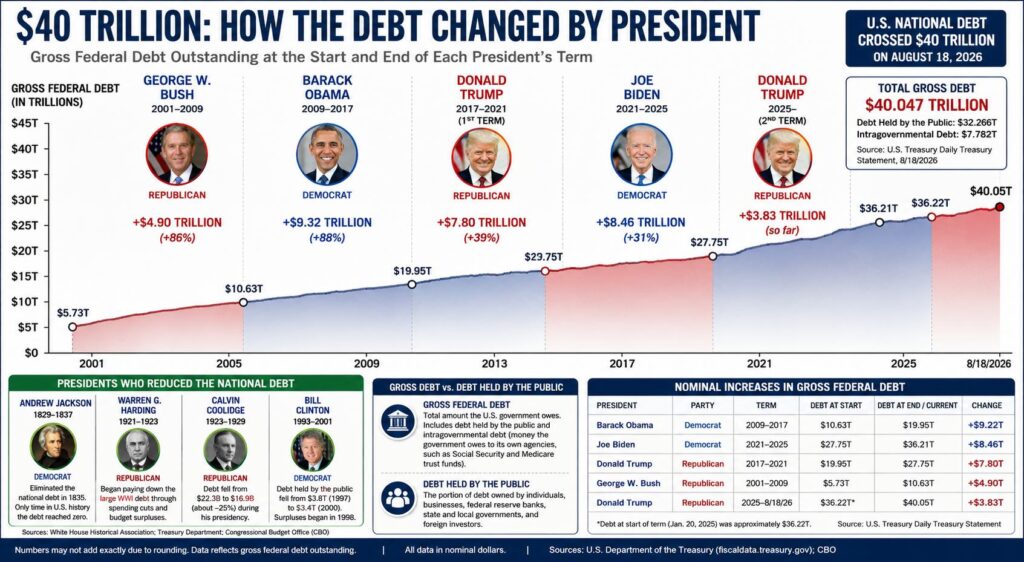
| President | Party | Approx. debt at start | Approx. debt at end/current | Change |
|---|---|---|---|---|
| Barack Obama | Democratic | $10.63T | $19.95T | +$9.32T |
| Joe Biden | Democratic | $27.75T | $36.21T | +$8.46T |
| Donald Trump — first term | Republican | $19.95T | $27.75T | +$7.80T |
| George W. Bush | Republican | $5.7T | $10.63T | about +$4.9T |
| Donald Trump — second term through Aug. 18, 2026 | Republican | about $36.22T | $40.05T | about +$3.83T so far |
Treasury data put the debt at $10.627 trillion when Obama took office in January 2009 and $19.947 trillion when Trump began his first term in January 2017. It stood at $27.752 trillion when Biden was inaugurated in January 2021.
Immediately before Trump’s second inauguration in January 2025, Treasury data showed gross debt at roughly $36.21 trillion. By August 18, 2026, it had climbed to $40.047 trillion.
Barack Obama — Democrat
Approximate increase: $9.32 trillion
Gross federal debt rose from approximately $10.63 trillion in January 2009 to $19.95 trillion in January 2017.
Obama therefore presided over the largest nominal increase of any completed presidency in this comparison.
Much of his presidency followed the 2007-09 financial crisis and recession. Federal deficits exceeded $1 trillion during several early years of the recovery before declining later in his administration.
Joe Biden — Democrat
Approximate increase: $8.46 trillion
The debt rose from approximately $27.75 trillion when Biden took office in January 2021 to about $36.21 trillion when he left office in January 2025.
Biden’s term began while the federal government was still responding to the COVID-19 pandemic. Congress approved additional pandemic relief under Biden, while later legislation increased spending in areas including infrastructure, semiconductor manufacturing and clean-energy incentives.
At the same time, some pandemic-era programs expired, causing annual deficits to decline sharply from their extraordinary 2020 and 2021 levels before rising again.
Donald Trump — Republican, First Term
Approximate increase: $7.80 trillion
Debt increased from approximately $19.95 trillion in January 2017 to $27.75 trillion in January 2021.
Federal deficits were already increasing before the pandemic. The 2017 Tax Cuts and Jobs Act reduced federal revenues relative to what they otherwise would have been, while federal spending continued growing.
Then COVID-19 dramatically changed federal finances. Congress and the Trump administration approved trillions of dollars in emergency relief during 2020. Reuters estimates that roughly one-third of the debt increase accumulated across the Trump and Biden years occurred during the extraordinary pandemic borrowing period.
George W. Bush — Republican
Approximate increase: $4.9 trillion
Gross federal debt rose from about $5.7 trillion when Bush entered office in January 2001 to $10.63 trillion when he left in January 2009 — an increase of roughly 86%.
His presidency included tax reductions, the wars in Afghanistan and Iraq, expansion of Medicare through the prescription-drug benefit, and the beginning of the 2007-09 financial crisis.
Donald Trump — Republican, Second Term
Increase through August 18, 2026: about $3.83 trillion
The national debt was roughly $36.22 trillion around Trump’s return to office in January 2025. It crossed $40 trillion on August 18, 2026.
Because Trump’s second term is still underway, this number cannot be fairly compared with completed four- or eight-year presidencies.
It does show, however, that the debt has risen by nearly $4 trillion during approximately the first 19 months of the current administration.
Dollar Growth Is Not the Same as Percentage Growth
Looking only at dollar amounts favors recent presidents because the federal budget, economy and existing debt are dramatically larger today than they were decades ago.
For example, Ronald Reagan presided over a much smaller dollar increase than today’s presidents, but federal debt roughly tripled during the 1980s.
Similarly, George W. Bush’s approximately $4.9 trillion increase represented about an 86% increase from the debt level he inherited.
That is why economists frequently examine debt as a percentage of gross domestic product, rather than simply comparing dollar totals. Treasury says debt-to-GDP is a better indicator of the government’s fiscal position because it compares debt with the size of the economy available to support it.
Which Presidents Actually Reduced the National Debt?
This question depends on which measure of debt is being used.
Andrew Jackson — Democrat
Andrew Jackson holds a distinction no other U.S. president has matched.
When Jackson entered office in 1829, the national debt stood at slightly more than $58 million. In 1835, the federal government completely eliminated the national debt.
It remains the only time in U.S. history that the national debt reached zero.
Warren G. Harding — Republican
The federal government began paying down the enormous debt accumulated during World War I during the early 1920s.
Debt stood at roughly $23.9 billion when Harding took office in 1921 and continued declining as the federal government produced budget surpluses and reduced expenditures.
Harding died in office in 1923, and Vice President Calvin Coolidge continued the same general fiscal approach.
Calvin Coolidge — Republican
Coolidge presided over one of the clearest sustained reductions in nominal federal debt in modern American history.
Debt fell from approximately $22.3 billion in 1923 to $16.9 billion by 1929, a reduction of roughly one-quarter during his presidency.
The broader Harding-Coolidge period was marked by repeated federal budget surpluses following World War I.
Bill Clinton — Democrat
Clinton’s record requires an important distinction.
Gross federal debt did not fall over his full eight-year presidency because intragovernmental debt — money owed by the Treasury to federal trust funds — continued increasing.
However, the portion economists often emphasize, debt held by the public, did fall during the final years of his administration.
CBO reported that publicly held debt peaked near $3.8 trillion in 1997 and had fallen to approximately $3.4 trillion by the end of fiscal year 2000, a reduction of about $363 billion. The federal government recorded unified budget surpluses beginning in fiscal year 1998.
That makes Clinton the most recent president associated with a sustained reduction in debt held by the public, even though total gross debt remained higher when he left office than when he entered.
Why Has the Debt Continued Growing Under Both Parties?
The $40 trillion debt did not result from one administration, one political party or one law.
Over several decades, federal spending commitments have grown faster than revenues. Major contributors have included:
- Social Security and Medicare spending as the population ages
- Defense spending and wars
- Tax reductions that lower federal revenue unless offset elsewhere
- Economic recessions that reduce tax collections and increase government assistance
- Emergency responses such as the COVID-19 pandemic
- Rising interest payments on previously accumulated debt
Treasury explains that persistent deficits require additional borrowing, which causes the national debt to grow.
Interest is becoming an increasingly important part of the equation. CBO projected in February 2026 that the federal government would run a roughly $1.9 trillion deficit in fiscal year 2026 and that debt held by the public would continue increasing over the following decade.
CBO projects debt held by the public will rise from roughly 101% of GDP in 2026 to 120% in 2036, exceeding the historic post-World War II peak.
Who Is Responsible?
There is no factually sound way to assign the $40 trillion debt exclusively to Democrats or Republicans.
Presidents influence federal finances through budgets, policy priorities, tax proposals, vetoes and legislation they sign.
Congress determines taxes and appropriations through legislation.
And every administration inherits commitments, interest obligations and economic conditions created before it took office.
The historical record shows substantial debt accumulation under presidents of both major parties, as well as rare periods of debt reduction under both Democratic and Republican administrations.
The Bottom Line
The United States crossed $40 trillion in gross national debt on August 18, 2026, according to the Treasury Department.
Among recent completed presidencies, Barack Obama saw the largest nominal increase in gross debt, followed by Joe Biden and Donald Trump’s first administration. George W. Bush also presided over a major increase, particularly when measured as a percentage of the debt he inherited.
Donald Trump’s current second term has so far coincided with an increase of approximately $3.8 trillion, but the term remains incomplete.
Historically, Andrew Jackson remains the only president under whom the United States completely eliminated its national debt. Harding and Coolidge oversaw major reductions during the 1920s, while Bill Clinton’s administration produced the most recent sustained decline in debt held by the public.
The broader historical record points to a less partisan conclusion: America’s national debt is the cumulative product of decisions made by presidents and Congresses from both parties, combined with wars, recessions, emergencies, entitlement obligations and the rising cost of servicing debt already accumulated.
When did the U.S. national debt reach $40 trillion?
August 18, 2026, according to the U.S. Treasury’s Daily Treasury Statement.
Which president added the most to the national debt?
Among recent completed presidencies measured by the nominal change in gross federal debt while in office, Barack Obama saw the largest increase, approximately $9.3 trillion. This does not mean Obama alone caused that borrowing; Congress, economic conditions and previously enacted policies also affected the debt.
How much did the national debt increase under Joe Biden?
Gross federal debt increased by approximately $8.46 trillion between January 2021 and January 2025.
How much did the national debt increase during Donald Trump’s first term?
Gross federal debt increased by approximately $7.8 trillion between January 2017 and January 2021, including extraordinary federal borrowing during the COVID-19 pandemic.
Has a U.S. president ever eliminated the national debt?
Yes. The federal government eliminated the national debt in 1835 during Andrew Jackson’s presidency. It remains the only time in U.S. history the national debt was fully paid off.
Is the national debt controlled by the president?
No. Presidents influence fiscal policy through budgets and legislation they sign or veto, but Congress has constitutional authority over federal taxation and spending. Economic conditions and existing federal obligations also affect borrowing.
