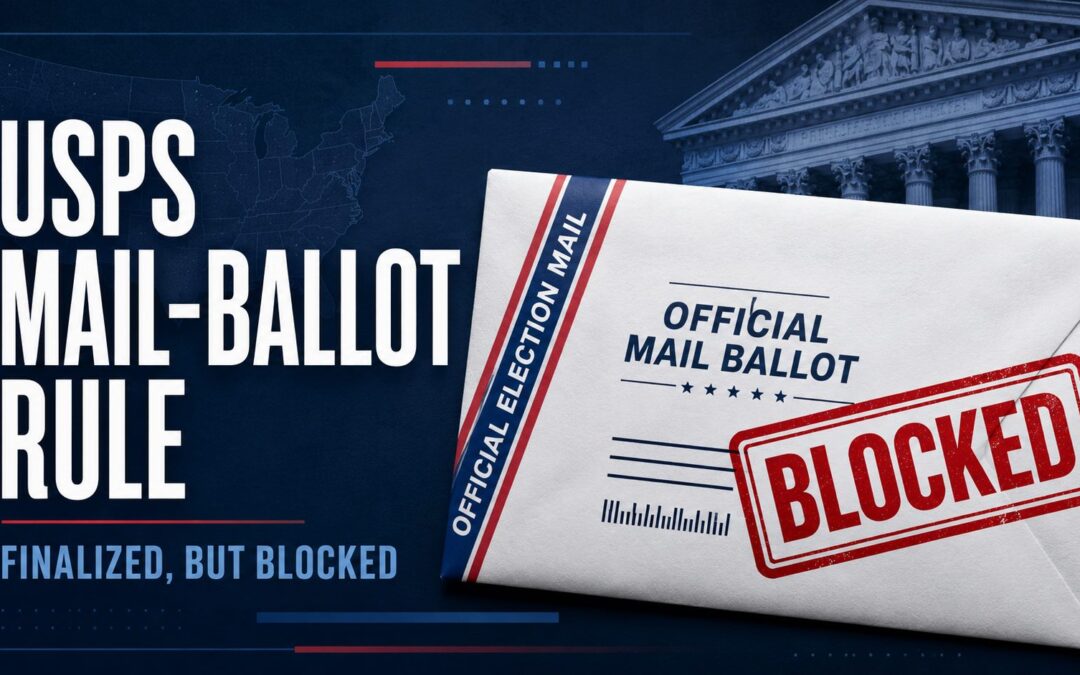
USPS Finalizes New Mail-Ballot Rules, but Enforcement Remains Blocked
Published: August 24, 2026
Updated: August 25, 2026
Status: Supreme Court lifts one injunction; separate USPS injunction remains in effect for the November 3 election.
Update: Supreme Court lifts one block on the executive order
On August 24, the U.S. Supreme Court voted 6–3 to temporarily lift an earlier federal court injunction that had prevented the Trump administration from implementing portions of its March election executive order in 23 states and the District of Columbia.
The decision in Trump v. California does not determine whether the administration’s mail-ballot policies are constitutional or whether the final USPS rule is lawful.
Instead, the Supreme Court focused on a procedural question: whether the states challenging the executive order had shown the type of concrete and immediate injury required to bring their lawsuit when it was filed.
The majority concluded that the states’ claims were premature. At that point, the executive order directed federal agencies to take future actions, including directing USPS to develop a mail-ballot rule, but the Postal Service had not yet finalized that rule.
The Court therefore stayed the lower court’s injunction while the government’s appeal continues.
Importantly, the Supreme Court expressly said its decision does not mean that measures taken to implement the executive order will necessarily be lawful. The Court also said states may challenge the USPS rule if the finalized regulation causes them legal injury.
Does the Supreme Court ruling allow the USPS mail-ballot rule to take effect?
Not currently for the November 3, 2026 election.
A separate federal court order issued August 11 remains in effect.
In League of Women Voters of Massachusetts v. Trump, U.S. District Judge Indira Talwani issued a preliminary injunction preventing USPS and its officials from implementing, enforcing or giving effect to Section 3 of the executive order for the November 3 election or any earlier federal election.
That injunction includes restrictions against refusing to transmit mail-in or absentee ballots under the challenged policy.
The Supreme Court’s August 24 decision involved a different lawsuit brought by states. It did not lift the August 11 injunction obtained by voting-rights organizations.
As a result, USPS has finalized its new mail-ballot rule, but the challenged provisions remain blocked from being implemented for the November election unless another court changes the existing order.
Why the distinction matters
There are two major court orders involved.
The first resulted from a lawsuit brought by California, 22 other states and the District of Columbia. The Supreme Court has now temporarily stayed that injunction while the appeal proceeds.
The second resulted from a separate lawsuit brought by voting-rights organizations. That August 11 injunction continues to prevent USPS from implementing Section 3 of the executive order for the November election.
Because of that second injunction, it would be inaccurate to say the Supreme Court has fully cleared the administration’s mail-ballot rules to take effect.
It would also be inaccurate to say the Supreme Court has ruled that the mail-ballot requirements themselves are constitutional.
What this means for voters
For voters, the practical situation has not changed yet.
The new USPS standards have not created new nationwide steps that voters must follow to cast their November ballots.
Voters should continue to:
- Follow the instructions provided by their state or local election office.
- Use the ballot and return envelope supplied by election officials.
- Meet their state’s deadlines for requesting and returning a mail ballot.
- Use official ballot tracking when their state provides it.
- Check official election sources for changes before relying on information circulating online.
States control many of the rules governing how voters request, complete and return absentee or mail ballots. Those rules vary significantly across the country.
What happens next
The legal fight now shifts toward the finalized USPS regulation and the remaining August 11 injunction.
The Supreme Court specifically noted that a finalized USPS rule can be challenged if it causes states legal harm. The final regulation is also already the subject of litigation before the federal district court in Massachusetts.
The administration could seek additional relief from the federal appeals court or Supreme Court in an attempt to lift the remaining USPS injunction.
Challengers, meanwhile, can continue arguing that the final rule exceeds executive or postal authority or conflicts with constitutional limits on federal control of election administration.
That means the legal status could change again before November.
Fact check: The Supreme Court lifted one injunction against the administration’s election executive order on August 24. It did not issue a final ruling approving the USPS mail-ballot restrictions. A separate federal injunction continues to block USPS from implementing the challenged provisions for the November 3, 2026 election.
CYS action step: Continue following the official mail-ballot instructions issued by your state and local election authorities. If another court changes the status of the USPS rule, Call Your Senate will update this article.
_________________________________________________________________________________________________________________________________________
Published: August 24, 2026 Status: Final rule issued; enforcement blocked by federal court orders The U.S. Postal Service has finalized new standards for mail ballots used in federal elections, including requirements for ballot-envelope designs, unique tracking barcodes and voter information submitted by election officials. The rule is scheduled for formal publication in the Federal Register on August 26. Although the document lists an effective date of August 21, USPS says it will not implement the requirements for the November 3, 2026, election unless the federal government first obtains relief from existing court injunctions. For voters, the immediate takeaway is simple: The new USPS provisions are not currently being enforced. Voters should continue following the official mail-ballot instructions issued by their state and local election authorities.
What the USPS rule would require
If permitted to take effect, the rule would establish new mailing standards for ballots in federal general, special and runoff elections. It would not apply to primary elections. State and local election officials sending federal ballots through USPS would be required to:
- Use envelopes carrying the official Election Mail logo.
- Make ballot envelopes compatible with automated postal equipment.
- Place a unique Intelligent Mail barcode on both the outgoing and return envelopes.
- Submit the voter’s name, mailing address and associated barcodes to a new USPS Federal Ballot Mail Portal.
- Submit ballot-envelope designs to USPS for review and feedback.
- Enroll mail-ballot recipients on a state-specific Mail-In and Absentee Participation List maintained through the portal.
USPS would verify outgoing ballot mailings before accepting them. A mailing that failed to meet the standards could be returned to the election office for correction. The verification procedure would apply to batches of ballots sent by election officials—not to completed ballots mailed back by individual voters. The rule states that postal employees would not be authorized to open sealed ballot mail or inspect how someone voted. These provisions appear in the USPS final rule available through the Federal Register’s public-inspection system.
Why the rule is not being enforced
The rule grew out of President Donald Trump’s March 31, 2026, executive order, titled Ensuring Citizenship Verification and Integrity in Federal Elections. Among other provisions, the order directed USPS to develop new requirements for transmitting mail and absentee ballots in federal elections. A group of states challenged the order in federal court. On June 25, U.S. District Judge Indira Talwani ruled that key sections concerning federal voter lists and USPS ballot procedures exceeded presidential authority and violated the constitutional separation of powers. That first injunction applied to the states participating in the lawsuit and covered the November 3 election and any earlier federal election. The First U.S. Circuit Court of Appeals declined to pause it on July 25. On August 11, Judge Talwani issued a separate nationwide injunction in a case brought by voting-rights organizations. That ruling prevents USPS from implementing the challenged mail-ballot provisions anywhere in the country while the litigation continues. The administration argues that the challenges were premature and that USPS has authority to regulate mail-processing standards. The challengers argue that the executive branch is attempting to regulate elections—a power the Constitution primarily assigns to states, subject to laws enacted by Congress.
What is before the Supreme Court?
On July 27, the Trump administration submitted an emergency application asking the Supreme Court to pause the earlier injunction involving the states. That request was filed before the separate nationwide injunction was issued on August 11. The Supreme Court had not ruled on the emergency application as of August 24. This distinction matters: Supreme Court action on the earlier injunction would not automatically erase every subsequent court order unless the justices’ decision or additional litigation also addresses the nationwide block. The National Constitution Center’s case summary explains the dispute and links to the relevant court filings. The administration’s application is also available directly from the Supreme Court docket.
Why this matters before November
States and local election offices must prepare ballot envelopes, voter instructions, databases and mailing procedures well before Election Day. Many jurisdictions begin sending absentee or mail ballots in September. If a court allows the USPS rule to be enforced close to those mailing dates, election offices could face limited time to:
- Redesign and print ballot envelopes.
- Generate voter-specific barcodes.
- Configure data for the USPS portal.
- Train election workers and mailing vendors.
- Update instructions provided to voters.
- Correct ballot mailings rejected by USPS.
Organizations that publish voting guidance could also need to update their information quickly. Military and overseas voters are especially sensitive to mailing delays because their ballots may travel longer distances. However, the final rule excludes certain ballots covered by existing USPS standards for military and overseas voting. Voters in those categories should rely on their election office and the official Federal Voting Assistance Program for instructions.
What voters should do now
The new USPS standards have not changed the steps voters must currently follow to cast a ballot by mail. Mail voters should:
- Verify their registration through their state’s official election website.
- Request a mail or absentee ballot by the state deadline.
- Follow the instructions included with the ballot.
- Use the return envelope provided by the election office.
- Return the ballot early enough to meet the state’s deadline.
- Use an official ballot-tracking service when available.
Requirements for requesting, completing and returning a mail ballot vary by state. Information from campaigns, advocacy organizations and social-media posts should be checked against official state or local election guidance.
What happens next
The Supreme Court may act on the administration’s emergency application, including granting the request, denying it or asking for further proceedings. The government may also pursue additional action concerning the nationwide injunction. Unless a court changes the present orders, USPS says it will not implement the new rule for the 2026 election.
Fact check: USPS has finalized a new administrative rule, but the challenged requirements remain blocked from enforcement. It is inaccurate to say USPS has already changed how voters must cast their November ballots.
CYS action step: Check your state’s official mail-ballot instructions and verify your voter status.
